Soft Landing Under Zero Visibility
The Economic Development Ministry in its updated macro outlook concludes that the economy is becoming more fragmented, that the growth has lost its comprehensive impact just over the latest months. According to the Ministry, by 2025 results the GDP will increase by 2,5% (last year – 4,1%), inflation will be at 7,6%, and the average annual US dollar rate will be ₽94,3. And the Center for Macroeconomic Analysis and Short-Term Forecasting expects that the GDP dynamics for the year will be about 1,3%.
Generally, in December 2024 – January 2025 there was a sort of a fork in the road for further development of all economic sectors of the RF, including the financial sector and the defense-industrial sector. The situation is and will be affected by multiple competing factors. Primarily, this is a trend for cheaper oil, stronger rouble, still high inflation and the CBR key rate, sanctions and prospects for tougher sanctions, some slump in consumer demand and “lending impulse”, ongoing labor shortage.
The base scenario (“soft landing”, as worded by the regulator) envisions that the economic growth slowdown process will be smooth and controlled, with inflation going down to 7-8% by the year’s end, key rate – down to the level of 19–19,5%, and GDP growth by 1,5%. The alternative scenario means the whole economy may stall with near-zero growth dynamics. This is why the Bank of Russia is in no hurry to ease the monetary policy (MP): the overall uncertainty is too high today. Particularly, as reasonably noted by Kirill Tremasov, advisor to the CBR head, a potential slowdown of the global economy due to trade and tariff wars is fraught with reduction of export revenues of the RF and “some pro-inflation risks”.
“Avoiding Recurrence”
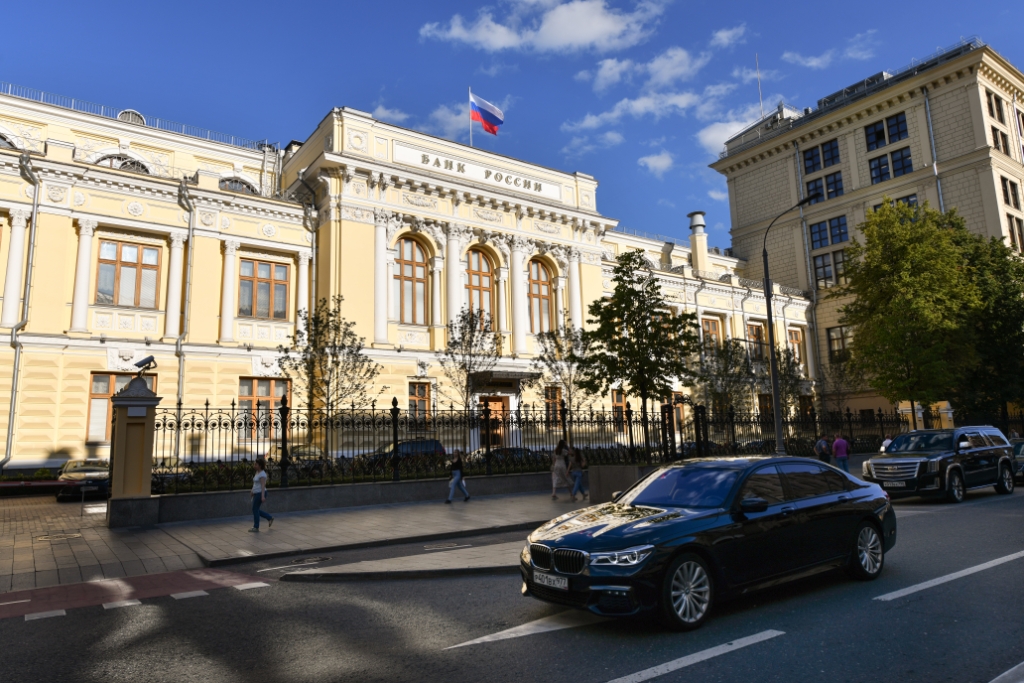
Leaving the key rate at the same level of 21% back in April, the Central Bank had somewhat softened its rhetoric versus the March meeting press-release, removing the statement of further possible raise of the key rate. The regulator noted that the current inflationary pressure, including sustainable, was going weaker, though remained high. However, subsequent data by the Rosstat dampened the dramatic message: particularly, over the period from April 22 to 28 the price growth had accelerated up to 0,11% from 0,09% for the previous weekly period (over the period from May 6 to 12 it slowed down to 0,06%). The year-on-year inflation amounted to 10,09%, which is somewhat lower than the April values. It is also important that the inflationary expectations of the Russian population in May also went up versus April by 0,3%, to 13,4%, as reported in a poll by “inFOM”, commissioned by the Bank of Russia.
“We ourselves often compare high inflation to high body temperature, - said Elvira Nabiullina, head of the CBR, at the April final key rate press conference. – And this drug, the high key rate, helps us manage overheating demand... But the prescribed treatment course has to be completed to avoid recurrence”.
And the main thing is that the threats (both domestic and external) for the base “soft landing” scenario, for economic stability remain in place. And until actual data provide sustainable confirmation of a trend for slower consumer price growth dynamics, the regulator will be treading cautiously and pragmatically. Its goal is not only to reduce inflation, but to ensure its sustainable position at the level of 4% by 2026.
“The inflation is still at two digits, and the inflationary expectations of the population have resumed growth after three months of reduction, - says Igor Rastorguyev, financial analyst. – Since these factors (and sustainable consumer demand and foreign currency market) are used as the primary benchmarks by the Bank of Russia, it does not have any grounds to ease its monetary policy. Indeed, the rouble exchange rate has strengthened since the start of the year, due to the mandatory sale of revenues in foreign currency and moderate demand for imports. But there are also powerful external conditions, shaping up risks for the global economy, which means they could negatively affect the inflation in Russia through the imports price channel. These are impacts of the new US tariffs on the world trade and commodity markets, and geopolitical tensions and many other things”.
Therefore, points out the expert, the current 21% rate reflects the balance between the need to control inflation and the risks of consumer demand overheating. At the same time, according to the expert, GDP growth slowdown rates do not seem critical. The state policy keeps working toward economic activity support — this includes implementation of infrastructure projects, subsidizing individual industries, investing into substitution of imports and an adaptive fiscal policy.
The Bank of Russia also leaves margin for maneuver, should additional support be required. Back in April there had been signs of the construction industry, processing industry and retail coming back to life. So, the probability of a coming recession is extremely low, as Rastorguyev sums it up.
“Oil Determines Almost Everything”
By the way, the Economic Development Ministry in its 2025 outlook under the conservative scenario provided for trade war escalation and stronger slowdown of the global economy. If this scenario unfolds, a barrel of Russian Urals oil may go down to $48,8 and lower, the GDP growth will amount to 1,8%, and the average rouble-dollar exchange rate could be at ₽96,6. Now the state budget is based on the forecast Urals export price of $69,7 per barrel.
“The Q1 oil and gas revenues contracted by 9,8% year on year, - says Nikita Maslennikov, lead expert at the Center of Political Technologies. – It stands to reason, that in order to offset these lost revenues, the Central Bank and the Ministry of Finance back in April had ramped up yuan sales under the budget rule to ₽10,5 billion per day, versus ₽6 billion in March. Until recently, the rouble price of Brent oil amounted to ₽6700, now it is about ₽5400. Revenues from energy products sales could only be increased under one obvious condition – if the Russian currency gets weaker. Now it is unusually strong (FX rate – ₽79,6), and we should aim for the interval of ₽90-96 per dollar”.
This will help balance the budget, where the budget deficit, according to the Ministry of Finance, amounts to ₽2,17 trillion (about 1% of GDP). Today almost everything is determined by oil: if the Urals remains at the current level, at the year’s end we will lose ₽700 billion of oil and gas revenues. And if it plunges by 30%, going below $40 per barrel, we will lose as much as ₽3 trillion, states Maslennikov.
“I expect the rouble to get weaker by September, - says Vladislav Antonov, BitRiver financial analyst. – Its current status is hardly sustainable over the long-term with further negative dynamics at the commodity market. After the imposition of the US sanctions on the Moscow Exchange in the summer of 2024, the Russian FX market had changed drastically. Now the FX rate is determined primarily by exporters and importers, and the lion share of deals is made in national currencies. Uncertainty is so massive that the rouble is as likely to get stronger as it is to go weaker. The real forecasting timeframe is no more than one week”.
For now, one could state there is a certain cool-down of economic activities, but there is no way this could be interpreted as a slump. This conclusion is made by the authors of the “Talking Trends” May bulletin of the Bank of Russia. According to them, this could largely be explained by the high base effect at the end of 2024, when there had been a one-off surge of production in base industries.
“At the same time the domestic demand, according to our estimates, demonstrated more sustainable dynamics, though its growth rate has been going down, among other, due to the impact of the severe monetary policy, leading to more balanced lending dynamics”, - says the report. As for the labor market, the researchers did not see any drastic changes there: unemployment is at a record low level of 2,6%, and at the same time the number of enterprises, experiencing labor shortages, has somewhat gone down.
Alexander Larin.