

Olga Guzhauskayte: “Hotel Stay Should Feel Better Than Home”
Mrs. Luxury
How was your company established? What did you start your professional career with?
The history of the ART Mebel Hotel brand is unique. It grew out of a personal story, which began 27 years ago. I, at the time a student with the Gubkin Oil and Gas University, worked as an office furniture sales manager at one of the very few companies at the former Soviet Union territory. The company was a representative of an Italian brand.
I had made a successful and quick career, because I was always result-oriented. Having worked for the company for two years, I climbed to the commerical director position: back then I had six people reporting to me. Then I decided to make yet another important step, which had changed my life. I felt I had enough of working for somebody, and that it was time to go and start my own company. Together with three other similarly passionate people, eager to launch their own business, we did not go into anything new at first: we continued selling office furniture. This was in 1994 — the year of bank and corporate office opening boom in Russia. At the time hotels were out of our focus altogether. The whole service sector at the time featured hotels like “Salyut”, “Cosmos”, “Golden Ring”. These were state unitary enterprises, owned by the government of Moscow, but it wasn’t clear for me at the time.
And then all of a sudden, an accident happened in my life, to later transform it into my lucky life journey. I fell ill, got into a hospital and had been recovering for a very long time. I had a lot of thoughts at the time. Once I got my eyes on a magazine, which featured advertisements of the “Hotel Business. Everything For Hotels” expo at the International Trade Center. Having looked at it, I thought: “Why does everyone work with offices, banks, apartments, homes? There are also hotels, and they need furniture as well”. So, I left the hospital almost carrying the magazine like a flag, came to my partners and said: “Well, thank you, it has been a pleasure working with you. I am leaving to establish my own company”. The ART Mebel Hotel name was born because our joint company with the partners was called “Art Mebel”. This how I decided to go into hotels. Naturally, I had support from my husband and friends, but no one gave me any money. Having worked for about three months in the niche, I had realized that the market there was really down.

Why is it?
First, globally, there are no manufacturers of off-the-shelf hotel furniture. You need to know manufacturers, where you could place a specific order, preparing a project in advance and providing technical documentation.
Second, there was nobody you could sell hotel furniture to. Nobody understood what I was talking about. We started calling hotels, and all hotels were in terrible conditions, but they would respond to us: “And why would we need hotel furniture? We went to a furniture store, bought a furniture set — a sofa and two chairs — and put it in our lobby, at the reception. That’s sufficient for us”. And this was when I understood that in this business things would not be as easy as they had been with office furniture. But this made it even more challenging.
I remember my first large project very clearly. This was the “Kedrovy Log” resort house in Surgut, owned by “Surgutneftegaz” company. I am a graduate of the Gubkin Oil and Gas University, and though I have not worked a single day in the field of my degree, but my education has helped me a lot. It sort of gave me three bonus points in this project.
How was the project implemented?
To get an understanding of what it was that we would be selling, I flew to a hotel and restaurant business expo in Milan. This is where I discovered the ins and outs of this field, and by the way, I am still learning. There is no off-the-shelf hotel furniture available: you put together each project as a construction kit. First, you get a strictly individual product of unique design, because no hotels look the same. Even if they belong to the same brand, to the same chain and are built by the same standards, they would still differ by interior design and decor.
Second, you can give your customer a good price, because you are not buying an off-the-shelf product, you are creating it as a manufacturer. This was the start of my long journey: I got to understand how it all works. And I implemented all of my insights in the “Kedrovy Log” resort house project. We did a very high-quality job there. It has been 25 years since, and though they usually start renovating hotels no later than in seven years, but everything had been done there with such outstanding quality, that they have not yet had to change anything. I am always very pleased to show “Kedrovy Log” in my reference list — the list of completed facilities, because this resort was where our great journey had started.
Magnificent Five
Which five projects have been the most interesting for you in terms of design and implementation over your career?
I would put first all the facilities we had done for the Olympics, because we have never had and probably won’t have ever again a larger-scale task both in terms of technologies and mental efforts. I would place here all of the Gazprom projects — the “Grand Hotel Polyana” hotel, “1389”, the Biathlon Stadium, the Biathlon Stadium Village. I have received a Presidential Certificate by President Vladimir Vladimirovich Putin and a medal for “Significant Input Into Preparation and Management of the XXII Olympics” for implementation of this whole complex. I am very proud of these awards too. This was an unforgettable project in terms of scale and emotion.
“Dobrograd” would come second, primarily due to the personality of its owner, the man that I am proud to have worked with — Sedov Vladimir Mikhailovich. “Dobrograd” is a unique project. This is the first private town, where an ideal space for living is created. And it all started with a hotel, designed and implemented by us.
I would then put the “Altay Village Teletskoe” in the third position, because now it is the most expensive hotel in Russia and the most visionary hotel in the Altai Republic, I believe. It should be noted that this is about private investment, which makes this hotel completely one-of-a-kind.
The fourth spot would feature “Hilton Leningradskaya”, because it is the first “Hilton” in Russia. The building was erected in 1953, which was during the Stalin era, and it is a really unique high-rise building, where chandeliers, staircases are all registered in the Guinness Book of Records.
It was very important for us to get this flagship project done. The tender back then featured 36 companies, but about 26 of these had never so much as heard a word about hotels. The competitive process in this tender was fascinating, and the implementation of the project topped all expectations. We were privileged to work with the Marcel Bequillard international design bureau with the headquarters in New York. “Hilton” engaged them in the project, and we, correspondingly, implemented it all. This was a very fascinating international format, something we miss very much today.
And I would put into the fifth position a small family hotel in Abkhazia — the “7 Cypress Trees” villa in Gagra, a boutique hotel with a mind-boggling location concept. The family history of its owners served as terms of reference for our design, and we never even had to invent anything. The father of the owners on his deathbed stated his will: build a house on this land, where you would greet visiting people. Let this house be as warm and hospitable as Italian houses in Toscana. They have followed through on his will and got a world-class project, visited by guests to immerse themselves in the atmosphere of “little Italy”.
Overall, there are almost two hundred projects in our portfolio, and they are all different. I remember each and every one of them, because they are all unique and I could tell a lot of stories about any project.
Kingdom Of Comfort
What does implementing projects mean for you — is it more of an art or is it applied technologies?
I would still put technologies first, because a hotel simply cannot have a design, which is not tied up both with standards, reguirements of the operator, who would be managing property, and with construction standards and regulations, Russian national standards etc. This is primarily about the ergonomics of space, about comfort for guests. And when they say: “Our hotel feels like home”, this is wrong, it should not feel as home. A hotel should feel better than home. Why would I leave my home, if you offer me what I have at home? Let me put it this way: naturally, concept, design and idea matter a lot. But I would still put the word “budget” first, “technologies” would come second and “design” would come third.
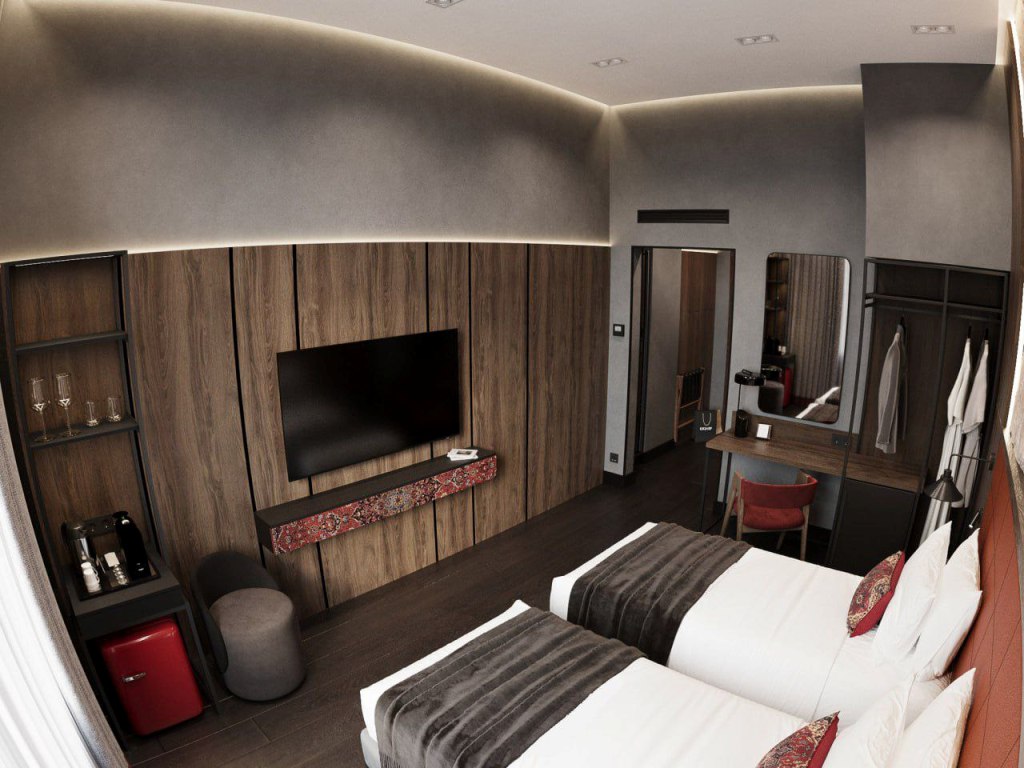
I have seen quite a lot of conceptual ideas, interesting spaces in hotels, where it would be impossible to stay. Some people here could make it very uncomfortable just for the sake of design. For example, you could enter a room and find a mini-bar in the bathroom, and a hair dryer in a cabinet in the room. Why is that? Why would you have it there? Or what would you say about three coat hangers in a hotel that hosts wedding ceremonies? People come with fully packed suitcases, but they open a hotel wardrobe and see that they can only hang three or four things.
So, technologies are paramount in hotel design?
Indeed they are. If we were making private interiors and a customer would require us to put up a bed on his ceiling, we would have to do this exactly. The customer would be the only one to use it, and nobody else will get hurt. But there is nothing else to be invented in the hotel sector: all the technologies to create a comfortable environment for people, to care for people, are already in place. This is why I am all for technologies.
Grateful To West, Pivoting East
How would you evaluate the current status of the hospitality industry? Has anything changed in Russia after the exit of the Western giants?
Since I travel a lot, I have noticed this: those who have been operating well under any brand, feel quite excellent now. This is because a brand is about strict standards, meeting requirements, and these are people, whole teams ready to uphold their standards. Our “Carlton”, which used to be the “Ritz Carlton”, is a most vivid example of this, the “Ritz” has gone, the “Carlton” stayed, but they have not lost their quality, not one iota.
On the other hand, those new hotels that are opening now and have never operated under any international brand, are showing very high service levels.
Of course, we have to say many thanks to the brands for teaching us many things: they cultivated the hospitality culture with us. In comparison with what we had back in the 1990s, current projects are worlds apart. And sometime ago large Soviet hotels thought they had been providing stellar services. So it is good that international brands came to Russia.
However, there is a more popular question that worries everyone now, what happens to the businesses when these brands come back? Now those hotels that have never operated under international brands, are flying high. If you talk to hoteliers, they would tell you that their occupancy rates are excellent and they have no need of any “Radisson”.
Are they reluctant to compete?
If we look at the results, then for instance, 10 years ago the Cosmos chain used to own 10 hotels, and now it has 40, and these are not their own hotels, but handed over to them for manegement. What do I see today in any city? There is either Cosmos or Azimut. So, it is overall excellent for the economy, business, development of our chains, our management companies. And it would probably still be better for us to pick hotels not by their nameplates, but by our own experience and recommendations of friends, as it has always been.
They say there is a designer boom in Russia now. This must be surely creating strong competition, is it not?
I will be frank, first, they do not teach hotel design anywhere in the country: there is not a single university where this subject is taught at least as a separate course. We are giving lectures at the “Detali” school, and this is the most advanced school in terms of design. We have 270 minutes there, this means these are three pairs of lessons of the “Hotel Design” course, pertaining specifically to technologies. But this is it.
What is my experience? Here I am, engaging new employees to work for us: all of them graduated from some specialized universities — the British Higher School of Art and Design, the Stroganov University of Design and Applied Arts, the Moscow Institute of Architecture. But essentially their level is zero. They know software, they can draw, they could write a diploma or a thesis, they can look up images over the Internet. I would not even mention any nuances, which come only with experience, but graduates from leading designer universities are unaware of elementary things: what is a soundproof door, how many decibel it should block, for example. Or they cannot explain how to make right sloping in a shower, for water to be drained properly.
So it turns out that nobody trains hotel designers?
Correct. And who would want to hire inexperienced personnel and teach them from scratch, invest in them? Of course, there are such organizations, who take this road. I won’t say we are the only ones on this market. There are a dozen companies with prominent names, excellent projects with fantastic reviews. But if you ask them, you’d find out that their way to achievements has been very complicated, among other due to shortages of talents with required skills.
And specific requirements are put forward for a reason. For example, no one in the world would invite a company into a hotel project, if there are no hotels in the company’s portfolio. And to build, let’s say, a new “Hilton”, you would have to be on the list of recommendations by the “Hilton” chain. This company would not just give a brandbook to an investor and say “Build it now!”. The company insists: “You have to choose from the designers or suppliers, recommended by us”. This happens because the parent company does not want to spend two years on design instead of just one year. It is reluctant to work with people who fail to understand essential things and to rectify their errors. Why would they need newbies, when they can work with professionals? That’s why they say: “We insist on engaging a company, recommended by us, with a portfolio of our brand”.
Is the experience of your colleagues from other countries helpful to you?
Now we do not have any communications. Of course, I am subscribed to many world-renowned designers, engaged in designing hotels and interiors, and I follow their new projects. But it is helpful only in terms of experience and visual savviness. For instance, now we are manufacturing furniture for the “Metropol” hotel. It was designed by a Singapore bureau, an Asian market leader in this area. I visited Oman and stayed at their hotel. It was fabulous! So, our primary goal in our cooperation with them is not to botch their design.
How do we cooperate? They came up with a concept, requiring specific materials. And we have no opportunity to buy the original materials to get this concept implemented. We start looking for an alternative, and it should be on par with the original in all key features. In our case, we had to get all materials approved by them “in the flesh”. Neither photos, nor images would have been enough to get a material approved. And we had to deliver materials to Singapore. We even shipped them a door section measuring one meter by eighty centimeters, so they could see the veneer layout, its tone etc. But it was also very important for us, and nobody could say to us: “This isn’t according to the project”. We have all the approvals from the project’s author.
And I am very sorry Russia lacks this culture.
What do you mean by this?
We often perform as project authors, but a customer could choose a different company to implement their project. Once we’ve had our work completely mutilated at the implementation phase. At the very start of the project I was in love with it and thought I would be proud of it, moreover, the project was located in a unique city.
Understandably, a project may be implemented over a long time. During this process manufacturing of some wallpapers could be discontinued, other wallpapers would need to look very similar to the previously selected ones, or, let’s say, a room’s dimensions could change by 10 cm and a specific bedside stand won’t fit in, but what matters most – visualization and implementation should be almost identical globally. As I am fond of saying in such cases: spot 10 differences, and these differences should only be visible with a magnifying glass, and not something that totally stands out.
And overall, how hard is the situation with supply of materials, for example, furniture, some components, after the exit of Western brands?
It is no longer hard, the situation has already been rectified, meaning that now you have an understanding of what cannot be delivered or used in any way. Basically, there are only a few of these categories: only those goods that are listed as dual-purpose goods. For example, electronic locks, previously used for room access via cards, these fall into this category. These are electronic devices and it is impossible to import them.
But let me remind you, that ever since 2012, back before the Sochi Olympics, it has been 13 years now of our transition to Russian-made furniture, its share now is up to 90%. Naturally, they always point out to us that all components are imported. But many components are manufactured at factories in Russia. Besides, China has provided excellent furniture fittings. Supply channels are up and running, there are vast stocks at warehouses. Overall, we were prepared to what has happened over the latest five years. This, by the way, has become our competitive advantage. We had started getting ready for challenges long before the pandemic or the SMO, preparing for import substitution and “pivoting East”, which has ultimately helped us.
Now to get one hotel room done, I have 18 subcontractors with vastly different material skills: some work with metals, others with stone, the third contractor would work with veneer, the fourth with laminated chipboard, the fifth — with solid wood, the sixth — with plaster, embroidery would be done by the seventh, fabrics handled by the fifth etc. This makes me think of a specific mission for me in this life — bringing together those who would have never met without our projects, let alone take part in anything global. For example, we cooperate with manufacturers who would never be able to get into a project of the “Metropol”, “National” of “Cosmos” level, even with their very high quality products, because they are very small. They do not have a sales department, which could sell it, promote, participate in tenders. But they can produce their niche product wery well. We have gathered them together under our wing. I believe, we have managed to bring together the most capable and talented craftspeople, workshops, mini-factories, give them an opportunity to make guaranteed money and do what they do best of all, without spending any time or resources on marketing and advertisement.
Vague Future For Emotion Masters
What will further development of your industry look like?
We are in a sinusoidal motion. We are doing contract work. We may have uneven sales periods from time to time, though there are exclusions. For example, we had peak demand the year before the last, because at the time money was provided by “Tourism.RF”. Now, of course, the rapid development has been suspended. The primary reason for this is that preferential financing is no longer available, and only very few could afford to build a facility with their own funds. In our country a hotel project would take at least a billion roubles, and lending at 30% interest is absolutely unfeasible, this means you can’t take out a bank loan. The hotel business with its 8-15% margins is unaffordable without support. This has led to suspension even of the previously announced projects, which has a pessimistic outlook, though I believe that the hotel business in Russia is still one of the most rapidly developing and socially focused in many respects.
Being an owner of a hotel in a nice location in our country is not only about money. It is largely about people. Every such project provides an opportunity for recreation, bed, excellent cuisine, pleasant living and moments, which would later be a part of personal stories, social media feeds, memories. You provide a service, and it is always about emotions, feedback, communication. This is the reason I did not want to go into private interior design: I was not happy with being unable to show my work to people. Results of this work will be viewed by 10-20 people at most, and I wanted to showcase my projects to the whole world. And my wish has been granted. My work is out there for all to see — for customers and hotel guests, acquaintainces and strangers, people of various incomes and fates, but I can show everyone the fruit of my labor, invested with so much of my energy, effort and love.