


Rare-Earth Metals: New Front of Global Confrontation
Trump’s tariff war, his claims on Greenland and Arctic resources, the meeting of the presidents of Russia and the USA in Anchorage, Alaska, the “Day of Disobedience” in Tianjin at the SCO Summit and the following online meeting of the BRICS countries, highlighting disagreement of the Global East and South with the “rules-based order” of the Western world – all of the above have had an effect on the development and further shaping up of a new global fight front – the fight for rare-earth metals or elements (REM, REE).
The growing geopolitical confrontation between the West and the emerging bloc of countries of the Global South creates a new front for competition — the fight for critical resources, where REM play a special role. These elements that are essential in the production of high-tech products, from microchips and batteries to military systems, are turning out to be a key strategic asset in the XXI century. The modern economy is entering an era, where access to rare-earth metals becomes an integral part of technological sovereignty. Control over REM production, processing and supply chains means control over the future — production of microchips, cutting-edge magnets, electric motors, satellite systems, hyper sound missiles and robotic complexes. This turns REM into a geopolitical influence tool, as significant as oil and gas in the XX century.
In response to the trade and tariff wars, started by Trump against the PRC back in his first term in office, Beijing played its trump card by introducing limits on rare-earth metal exports. It is China that dominates today the production, processing and supply chain for these elements, and most of the global high-tech corporations are dependent on their exports. An interesting trend is emerging: if the USA restricts its technology and electronic component exports and introduces high tariffs on products from China, then the Chinese government would respond with a ban on exports to the USA and the countries, connected to them, of resources, without which it would be impossible to develop high technologies, and would also introduce export controls on natural resource processing technologies, having huge advantages in this area.

Realizing the emerging shortage of valuable resources, now subject to export controls, and the dependence on the main economic competitor, the American president declared claims on Greenland and Canada, rich in natural resources, including REM. Beijing was also eyeing the riches of the Arctic territories. Greenland has a major deposit of rare and rare-earth elements, Tanbreez, targeted for purchase by a Chinese company. But American officials pressured its Danish owners and forced them to sell the deposit to a New York-based Critical Metals Corporation in 2024. Another large deposit, Kvanefjeld, still went to the Chinese, since it had been bought by them long before the start of the rare-earth metals race.
Amidst global confrontation and disrupted global trade with revised partnership relations, the issue of lack of required raw materials in one’s own home territory is becoming vital. This is why it is so important to control resource-rich territories.
The battle for Arctic resources is only picking up steam now, and Donald Trump would probably prefer to view Russia, a country owning significant Arctic territories, as a manageable partner, and not as a tough competitor, also having such advantages as a powerful icebreaker fleet and control over the Northern Sea Route. It is no chance that the Alaska meeting of the two presidents was marked with preliminary agreements on joint development of Arctic deposits. According to some reports, deposits in the new Russian territories, previously featured in the resource deal between the USA and the Ukraine, were also discussed at the meeting.
According to the Ministry of Natural Resources, Russia has up to 28,5 million tons of REM, which puts it in the top five leading countries. However, until recently industrial processing has been Russia’s weak spot. To overcome this weakness, Vladimir Putin has initiated a “New Materials and Chemistry” national project, focused on development of a full cycle of rare-earth element processing. Currently the Russian mining of rare-earth metals is primarily concentrated at the Lovozero Deposit in Murmansk Region, and the key processing asset is the Solikamsk Magnesium Plant (SMP) in Perm Region. The first 2600 tons of concentrate were produced in 2022. According to the plans of Rosatom, which is actively developing the area, by 2030 Russia is supposed to become self-sufficient, achieving production volumes of 7500 tons of REM per year. The long-term outlook is even bigger: according to the RF Ministry of Natural Resources, development of large Tomtor deposit in Yakutia will enable the country to meet the current global consumption of rare-earth metals for over 100 years.
Russia is currently developing technologies for production of separated REM oxides, building industrial complexes for their production, including the most in-demand magnetic materials, such as praseodymium, neodymium and dysprosium.
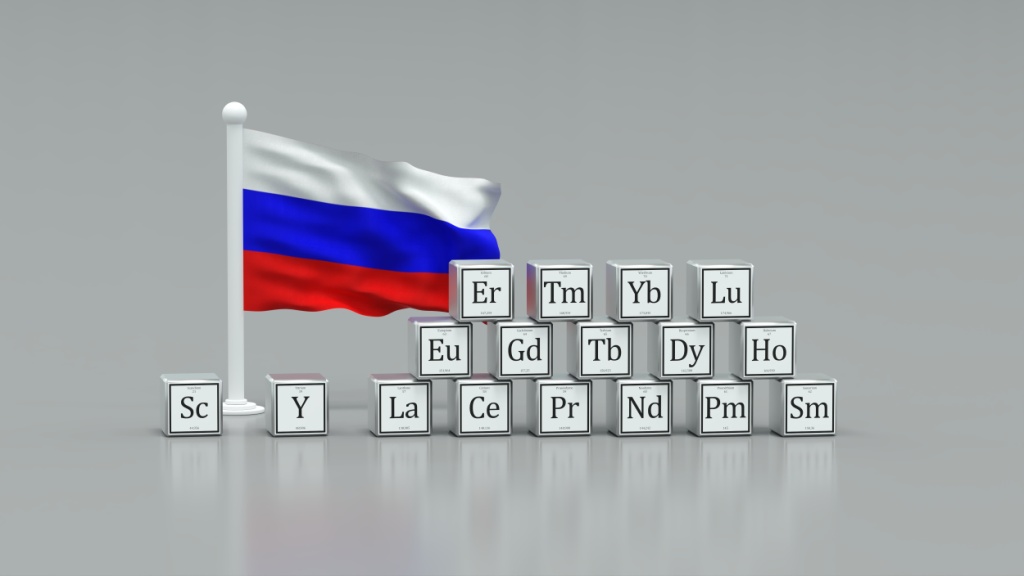
As a result of Vladimir Putin’s visit to China early in September 2025, it has become known that Beijing is as much interested in Russian deposits of critical resources, as are the USA. At this time there are ongoing discussions on engaging Chinese partners in production of rare-earth metals, though no final decision has been made yet. Vice-Prime Minister Denis Manturov specified, that Russia is primarily interested in REM oxide extraction technologies. “Today this is a cutting-edge technology, and it is owned by China and the USA”, — he added. However, it should be clarified here, that the Societ Union possessed relevant separation technologies, which have been lost. Now Russia is trying to recover these technologies. While there are ongoing negotiations with foreign partners, the Solikamsk Magnesium Plant is launching a major rare-earth production facility, based on available knowledge and practices. It is planned that in 2026 the plant, owned by Rosatom, will have a facility for production of cerium, neodymium, praseodymium, lanthanum, and also samarium, gadolinium and europium concentrates.
Speaking in September 2025 at the plenary session of the Eastern Economic Forum, RF President Vladimir Putin said that he had instructed the government to approve a rare-earth industry development strategy by November. He noted, that a resource inventory system was up and running, these reserves are available for extraction and use. According to the President, it is necessary to implement advanced technologies and develop domestic demand. Thus, the focus is on the development of domestic high-tech industries, and not on exports.
Previously the head of the Ministry of Industry and Trade Alikhanov said that Russia was planning to reduce the share of rare-earth metal imports by 2030 down to 45% from the current 75%.
So, today Russia is betting on the development of its own production and REM oxide separation technologies, but it is prepared to consider cooperation proposals both from the USA and from China. Specific partnership parameters and formats have not yet been finalized, but all participants will unlock promising opportunities for themselves.
The ultimate goal of Russia is not only an increase in production volumes, but development of a competitive, technologically advanced industry. Possessing colossal resources and recovering lost competencies, the country has all the potential to establish itself as a “pillar” of the REM market, capable of competing on equal terms with leading global players and influencing the rules of the game.