

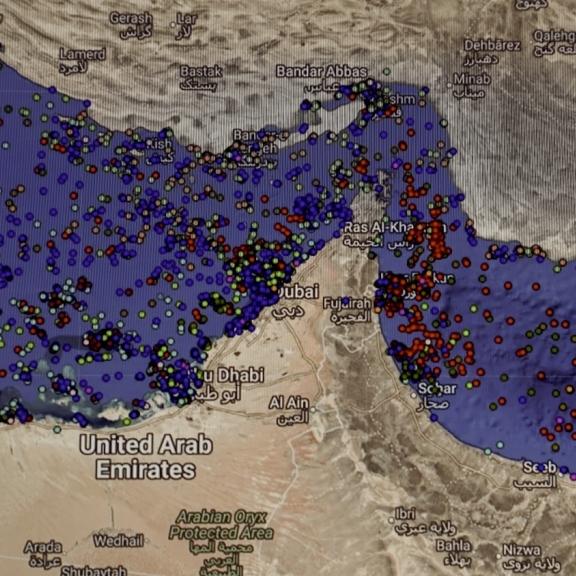
The Strait of Hormuz Impasse
In the view of U.S. Representative Pat Harrigan, the situation has clearly reached a stalemate from a military standpoint—though the deadlock extends far beyond just the military domain. "A risk premium can only fall so far while the underlying security issue remains unresolved," notes Priyanka Sachdeva, senior market analyst at Phillip Nova.
In early September, the US launched airstrikes against Iranian targets in the Strait of Hormuz area. As a result of one such action in the Iranian province of Hormozgan, where a wedding ceremony was taking place, five wedding guests were killed and another 68 were injured. In response, the Islamic Republic attacked US military facilities in Bahrain, the UAE, and Kuwait. Additionally, Israel declared its readiness to resume hostilities in the event of an Iranian attack.
"Hopes Are Fading"
As a result, there are currently no clear signs of easing military-political and market tensions, and the Strait of Hormuz, through which about 20% of global oil supplies passed before the conflict, remains de facto blocked. On the morning of August 27, the United Kingdom Maritime Trade Operations (UKMTO) reported another incident involving a tanker in the strait. The vessel was hit by an unidentified projectile, which caused a fire. According to the Fars News Agency, the previous evening, Iranian forces prevented an Indian tanker from passing through the strait along the southern route near the coast of Oman. A few days earlier, President Donald Trump announced the launch of an operation to exert powerful economic pressure on Tehran, which, according to him, had missed the opportunity to reach a deal with Washington on disputed issues. Experts have no doubt that against the backdrop of these events, the global oil deficit will continue to grow, reinforcing the trend toward a steady rise in prices.
"Brent crude prices are literally just a step away from the psychologically significant mark of $100 per barrel, while the Russian Urals blend is likely to continue trading within the $75–95 per barrel range," says Guzel Protsenko, CEO of Alfa-Forex. "The main supporting factor for quotes remains geopolitical uncertainty surrounding the Strait of Hormuz, which has only been intensified by recent, highly alarming events in the region. This maintains a risk premium in commodity futures, as the market has dwindling hopes for a recovery of traffic through the strait. It is evident that the future dynamics of oil depend entirely on how the situation develops around this key route".
As for Russia's interests, the current situation is rather a benefit, as it increases potential export revenues and supports budget receipts. At the same time, more expensive oil creates the conditions (albeit mostly theoretical) for strengthening the rouble through an increased supply of foreign currency earnings from exporters. However, one should not rely solely on the commodity factor when forecasting the exchange rate. The foreign exchange market is simultaneously influenced by the monetary policy of the Bank of Russia, the volume of domestic demand for foreign currency, and external conditions. Therefore, the effect of rising oil prices may only manifest with a certain time lag.
“The situation around the Strait of Hormuz is becoming increasingly deadlocked and, undoubtedly, long-term,” notes Vladimir Zernov, a financial analyst at Bitbanker. “It arose because neither the US nor Iran could gain an advantage in the armed conflict and shifted to economic battles. However, a new wave of military escalation was not long in coming. The Trump administration is betting that the Iranian economy will collapse under the weight of sanctions and port blockades. Tehran, on the other hand, believes that rising commodity prices will force the Americans to back down. Meanwhile, global oil reserves continue to deplete, creating the prerequisites for further price growth and exceeding the $100 per barrel mark in the absence of any agreements between the United States and Iran”.
For Russia, all this means a completely positive dynamic in foreign exchange earnings, as well as a reduction in discounts on the Urals grade—the less oil there is on the market, the less fastidious buyers become. As for the rouble exchange rate, these events have no immediate impact on it: currency flows into the country with a significant lag, which can exceed one month.
Premium for Russia
“Quotes are rising for completely understandable reasons, largely related to Trump's threats against Iran and those states that will not comply with the U.S. blocking regime against the Islamic Republic,” notes Igor Yushkov, an expert at the Financial University under the Government of the Russian Federation. “The Americans are firmly determined to squeeze Iran with an economic blockade and even harsher sanctions, as the military campaign did not yield the desired effect. And this is already working: as the country's authorities, represented by the head of the Central Bank, admitted, their oil exports have effectively dropped to zero. It is forbidden to trade with Iran, supply any goods, or maintain contacts. The situation is further escalating as a result of Tehran's retaliatory steps; in particular, its proxies—the Yemeni Houthis—have intensified strikes on Saudi Arabia”.
Accordingly, traders do not believe that normal shipping and oil supplies from the region can be re-established in the Strait of Hormuz in the foreseeable future. Everyone expects further cumulative reductions. For Russia, however cynical it may sound, any escalation of tensions in the region brings economic benefits in terms of commodity prices. It frees up market share for the country. If Iranian exports are indeed zeroed out, China will require replacements from alternative suppliers, an analyst notes: Tehran shipped virtually all of its oil there—either directly or via transit through Malaysia.
Consequently, China can now only buy Russian oil at a discount—purchasing it without a discount makes no economic sense. Previously, Beijing had a stable option with Venezuelan oil, but today the situation is entirely different: the Americans are gradually lifting sanctions on Venezuela, and its oil is now primarily flowing to the US market. Additionally, due to the closure of the Strait of Hormuz, Saudi Arabia—once an absolutely reliable source—has dropped out of the picture. According to Yushkov, this is why we are currently witnessing another round of competition for Russian oil between China and India. As a result, the discount on Russian oil is shrinking, and it often turns into a premium at destination ports. India's position, by the way, is comparable to China's. Iraq used to be its second-largest supplier after the Russian Federation, with Saudi Arabia ranking third, and the UAE fourth. Today, all of them are barred from freely exporting oil to the global market, once again due to the ongoing crisis in the Middle East.
Alexander Larin.