


The End of the Bretton Woods Era: What Lies Ahead?
The emergence of a multipolar, inclusive world – a process currently gaining momentum - is impossible without the formation of a new global financial system. The old Bretton Woods architecture, based on the US dollar as the world's reserve currency, is tailored to serve the interests of the United States and the West as a whole. Today, it has definitively transformed into a punitive tool and acts as a barrier to the development of the majority of nations.
International Law Violated
Sanctions. Secondary sanctions. Disregard for commitments made. The freezing or even confiscation of foreign assets of other states in dollars and euros, as well as gold deposits. Hundreds of billions of dollars in state assets belonging to Russia, Iran, Libya, Syria, Venezuela, and Afghanistan have been frozen. These assets are being managed against the will of their owners.
Most-favored-nation treatment for some states, and draconian measures for others. The IMF and the World Bank pursue an overtly biased policy, granting preferential terms to some while imposing draconian demands on others.
The SWIFT international payment system has been turned into a geopolitical tool used to exclude states and legal entities deemed "unfriendly" by the West from global economic relations.
Three Stages of Change
The current situation is fundamentally at odds with the aspirations of the majority of the world's nations. New international financial, credit, and payment systems are urgently needed.
"It is obvious that the current dollar-oriented global financial system will be replaced by a new one, based on the consensus of countries that join the new world economic order," asserts Sergei Glazyev, a prominent Russian economist and State Secretary of the Union State of Russia and Belarus.
Of course, the task of building a new financial architecture is extremely complex. There are many differences in the interests and positions of states. Countries are also wary of stepping on the same "Bretton Woods rake" and replacing US dictation with another state's ambitions for dominance.
Finally, the West is actively resisting change, declaring a war of tariffs and restrictions against it, and even resorting to military force, as in the case of Iran.
While there are many concerning nuances, it is equally clear that change is inevitable. The principles that the new system must adhere to are also apparent. It must provide equal opportunities for all participants, remain independent of the positions of the most developed nations, refrain from dictating conditions for economic and socio-political development, avoid replacing national financial and economic authorities, and not be isolated from other systems, yet remain independent of them.
Despite the uncertainty of many nations and the resistance of the West, the process of forming a new financial and credit system is already underway.
The share of the US dollar in official state reserves is rapidly declining. According to IMF data, over the past twenty years, it has dropped from over 70% to below 60%. At the same time, the reduction in the dollar's share has not led to an increase in the weight of the euro, yen, or pound sterling. On the contrary, the volume of national currencies used in mutual settlements between states is growing.
In addition, alternative development banks are being formed, independent payment systems are being created, regional trade and economic alliances with liberal mutual trade terms are emerging, and bilateral customs agreements for an open market are being concluded.
According to Glazyev, the shift of nations away from the currencies of the US, UK, EU, and Japan, the creation of regional trade and economic alliances, and other steps constitute the first stage of forming the new system.
The next, transitional stage will incorporate pricing mechanisms that are not pegged to the dollar.
In the third and final stage, a digital payment currency will emerge.
"Such a currency," says Glazyev, one of the developers of this project to form a new global financial system, "could be issued by the BRICS Currency Reserve Pool. All interested countries will be able to join it. The weight of each currency in the basket can be proportional to the GDP of the participating countries, calculated by purchasing power parity, and their share in international trade. The basket could also include a price index for major commodities, and anything else the participating states deem necessary to take into account".
According to expert Glazyev, this new currency will be used exclusively for cross-border payments and will be issued to participating countries based on a predetermined formula.
Within the participating countries, national currencies will continue to be used.
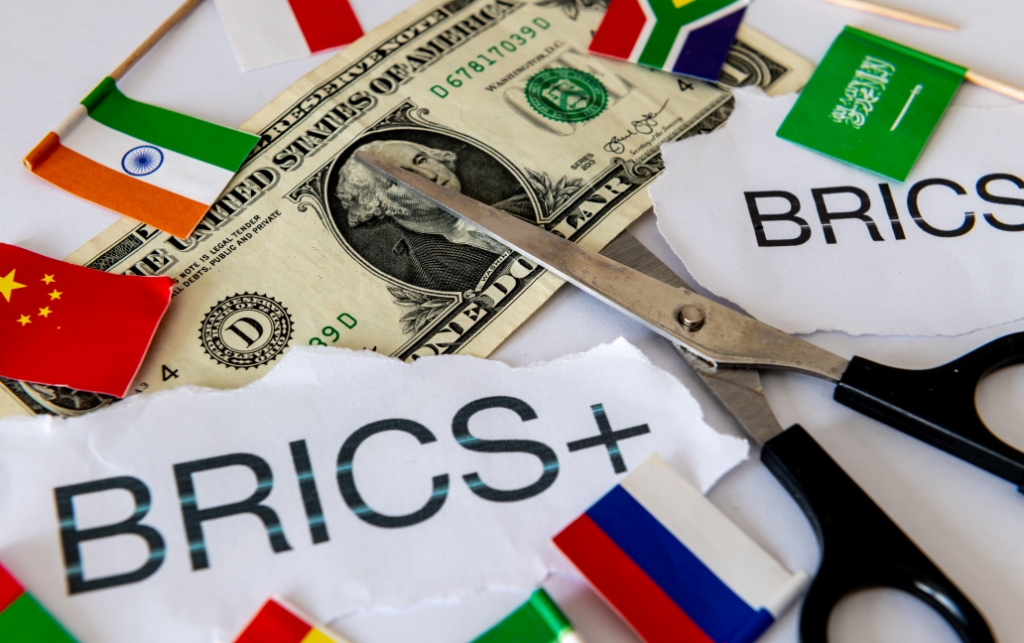
Common Currency Is An Absolute Must
For several years, the well-known Brazilian economist Paulo Nogueira Batista studied the operations of the IMF and the BRICS New Development Bank while working in senior executive positions within these organizations. He concluded that "the existing monetary and financial system cannot be fundamentally reformed. Gradual or partial adjustments can be made, but the underlying inequality will remain".
Batista developed his own vision for the potential architecture of the future global financial system. In his view, the structure already created within the framework of BRICS could serve as the foundation.
Why BRICS in particular? "Because today it is the largest and most representative entity systematically engaged in building its own credit and financial architecture," he said.
The BRICS New Development Bank (NDB) already includes nine member countries. This financial institution offers alternative programs to the IMF for nations facing balance of payments issues.
The Contingent Reserve Arrangement (CRA) has been operational since 2015. The total volume of the fund stands at 100 billion dollars.
In 2024, Russia launched the BRICS Cross-Border Payment Initiative to conduct international settlements bypassing SWIFT.
The key components and mechanisms of the initiative will be: BRICS Pay – a decentralized, multi-currency platform and mobile application for retail C2B payments; BRICS Bridge – a unified settlement platform for interbank operations and cross-border transfers.
The Reserve Bank of India proposed the Integration of Central Bank Digital Currencies (CBDCs) for direct cross-border trade payments.
For these bodies to function more effectively, an alternative reserve currency is needed, Batista believes. "In fact, we need something unprecedented in world practice: a global currency that does not serve the objectives of a specific state or group of countries. This 'single currency' will not replicate the Euro model. Therefore, there will be no loss of sovereignty, no common monetary policy, and it will not even require coordinating national monetary policies," he said.
He proposes creating a more conventional, non-digital single currency. It would be issued by a new international financial institution – an issuing bank. According to the Brazilian economist's design, its sole and exclusive function would be the issuance and introduction into circulation of the new currency.
"The new currency will circulate in parallel with the national payment instruments of the sponsoring countries and other existing national and regional currencies in the world," Batista said. "Its function will be limited to international transactions, and it will play no role within any individual country". The global economic architecture—a fact now recognized by everyone without exception – is undergoing tectonic shifts. The existing system suffers from inherent instability and inequality. It is in the interest of the majority of countries to establish reliable mechanisms for collective protection against economic shocks.
"The time has come to move forward and create alternative payment methods for transactions between nations. This is not about replacing our currencies. However, we need to work towards ensuring that the multipolar order we wish to build is reflected within the international financial system as well," said Brazilian President Luiz Inácio Lula da Silva at the BRICS summit in Kazan, Russia.
"We need to agree on common rules and standards for financial interaction," Sergei Glazyev believes. "Undoubtedly, the ongoing processes will continue to develop. The American and global debt bubble has expanded to a size where it has ultimately ceased to be sustainable. Theoretically, the debt bubble could burst at any moment, and even a relatively minor event could trigger it".
Alexander Chertkov