

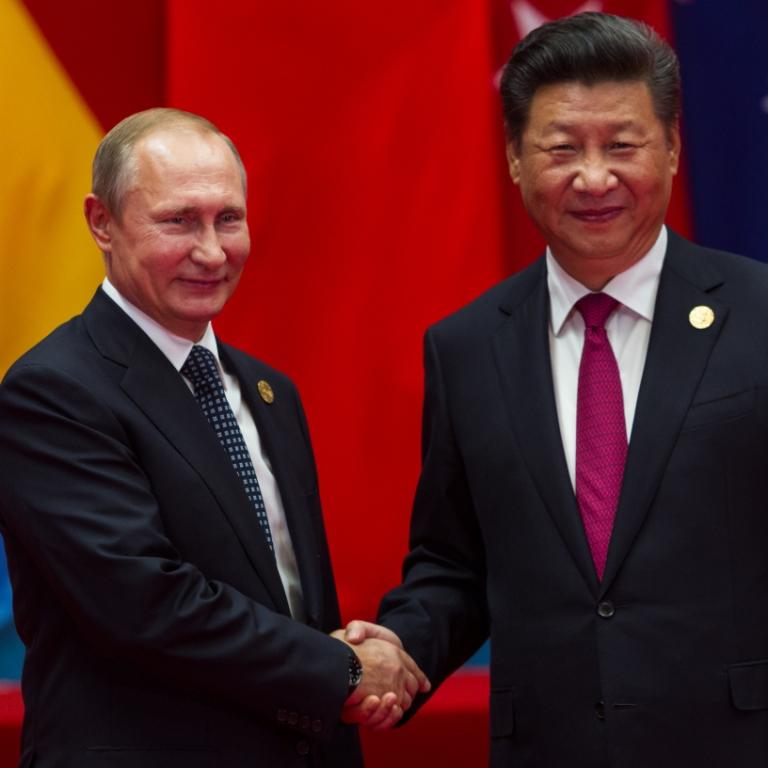
Russia and China: Deeper Economic Convergence
Ten years ago it was common thinking that China had a master plan in Eurasia, and that Russia was only a modest second-rate player according to this plan. This master plan envisioned that China would reach out to the EU market following the Great Silk Way, and Russia’s Northern Sea Route would add up yet another route, further improving connections between the markets. Russia would be making some money, but would not gain any political and economic benefits.
Today the Belt and Road initiative is facing a lot of challenges. The Eurocracy is threatening to ban imports of Chinese goods, with the USA leading the way. The US started a war against Chinese smartphones and microelectronics in general, and in 2023 American corporations reduced their purchases of goods from China. This formal reduction of the flow of Chinese goods to the US market could very well become a real thing. The EU may deal a very painful blow to China, because it is the most important export market for China. The European Commission has already discussed a possible ban on Chinese goods at the EU market.
Russia has been developing its own plans to ramp up trade with the EU, envisioning, first, construction of Nordstream 1 and Nordstream 2 gas pipelines to increase oil and natural gas exports. Second, the Trans-Siberian Railway and Baikal-Amur mainline (BAM) transit volumes have been expected to climb over the 2% share of all China’s container export volumes. Third, Russia’s participation in the Belt and Road initiative was supposed to expand export of domestic goods and bring Russia and the EU closer together. There was a hope that this would reduce tensions with Brussels, caused by the foundation of the Eurasian Economic Union (EAEU).
All of these plans and hopes have gone down in flames, only to be replaced by a new economic reality taking shape and fast multi-faceted convergence of Russia and China. “Owing to the diplomacy of leaders, Russian-Chinese relations are demonstrating their adaptability to most challenging conditions”, - as Russia’s Foreign Minister Sergei Lavrov said in April 2024 in view of the upcoming state visit to China of the Russian President Vladimir Putin. In 2021 the trade turnover between the countries amounted to $140 bn. In 2022 this figure rose even more, and in 2023 it went over $240 bn. A new milestone of $300 bn is looming ahead. New links and new dynamics are being developed.
The summit of the Russian leader and the Chairman of China Xi Jinping has shown that the countries have an understanding of a global development strategy. The world is different from what it was ten years ago. This is why both countries are seeking to protect their sovereignty from the West, which has decided to turn China and Russia into its colonies and strip them of their industrial and prosperity growth potential. Moscow and Beijing’s foreign policy is focused on exhausting the USA and their satellites, on cooling down their bellicose fervor to avoid a global nuclear war and mankind extinction. It would also be important to clamp down on the terrorism in Eurasia, nurtured by the USA from religious fundamentalism, national-neoliberalism and outright Nazism.
Comfortable conditions for private investment and implementation of a stimulus policy must be fostered. Instability at the Old continent must be replaced with sustainable rules, stable growth of production and trade. During this process it would be required to expand and reinforce a group of countries across the world, focused on development, independent from the West, and with the help of these countries to build a world, based on international law and mutual respect. This work needs to be premised on mutually beneficial exchange of goods and services, freedom and protection of capital investment in each other’s territories. And it is very important to highlight that China is becoming an economy of industrial machine building.
The former trade expansion strategy of China envisioned that other countries (including Russia) would focus on supplying raw materials to China, consuming more and more Chinese industrial products. But the new political circumstances have changed everything. Russia needs to develop its own manufacturing industry, including machinery manufacturing. This process is already to a large extent supported by purchases of manufacturing equipment, machines and equipment from China. Similar things are happening in Central Asia and many other countries across the world. It turns out that buying from China is much better than buying from the EU, the USA, Canada or Japan. But we are still in the early phase of the process, which will make the machine building sector of the PRC even more significant.
By ramping up its equipment and spare parts exports, China will be supporting its consumption growth, thus stimulating production and consumption growth in Russia. And this process has already shown that it is not China that has excessive industrial capacities, as has been recently stated by Janet Yellen, the US Secretary of the Treasury. Up to 30% of the industrial capacity of the EU could be considered excessive, since these have been rendered non-competitive due to anti-Russian sanctions. Things are not going well for the UK, Canada and even the USA, despite an influx of capitals from the economic disaster zone in the EU. The West has yet to get rid of its production capacity which is excessive for its current status and plunge into a social and political crisis period, for its current leaders to lose power in their respective countries.
The growth of Russian and Chinese economies under these circumstances will be largely based on the principle of interconnected vessels: when something is lost in one place due to pressure, then something is gained at the other place. One should not be misled by the fact of intense discussions in the West and especially in the EU of a looming crisis and recession. Growth and development of Russian, Chinese and a whole range of other economies will be happening on the back of contracting Western middle class and weakening business activity, unlike the effects of their growth in 2001-2019. Naturally, relatively high interest rates of Western central banks are putting pressure on the global economy, but these will not be an obstacle for the Russian-Chinese cooperation.
All of the above could be viewed as a new growth formula for Russia and China. The formula shows promise to be operational at least till 2040 without any major complications and with mid-size commercial crisis interruptions. Country markets will continue expanding, thus generating return on investment. Naturally, this process will involve a lot of politics, much more than during the previous era. The risk of a West’s trade war against China is growing, which could lead to major reductions in China’s exports to the EU, the USA, Canada, Japan and other countries under American influence. China is reducing its holdings of the US government bonds and sending signals to US diplomats that it would continue fighting. This fight would guarantee further development.
Russia is searching for and finding new foreign markets for its goods. China will have to do the same. Not everyone is happy with this, though the economic war of the West against China is still in its early stages, key events are still up ahead. Some are still hopeful that the relations with both Moscow and Beijing will “get back to normal”. But the odds are that the rivalry would only become more intense. In terms of economy, this will not curb growth and development of Russia and China, it won’t even contain them, since the process will transform and go on.