

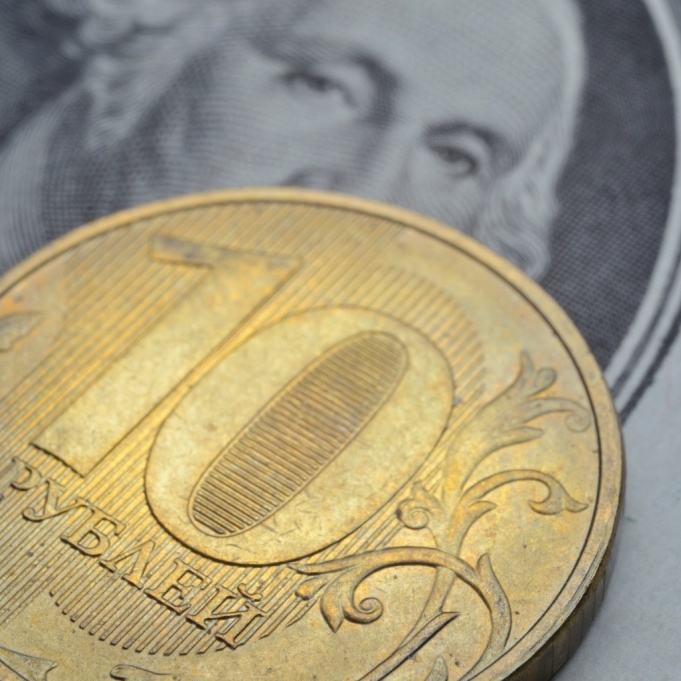
June Marked a New Phase for the Rouble
The first summer month indeed became a turning point for the rouble. By its end, the Russian currency weakened against the dollar by 10.2%, to 78.3 roubles, and against the yuan by 10.8%. The exchange rate returned to early-year levels, prompting a revision of forecasts for the second half of the year. At the same time, analysts generally view the current development not as the beginning of an uncontrolled decline, but as the result of simultaneous shifts in several market factors.
The dynamics of oil prices played a major role. In January and February, Russia's benchmark Urals crude traded slightly above $40 per barrel. In March, amid events surrounding Iran, spot prices rose to $77, and in April, they hit $95 per barrel. By early July, prices corrected to $50–51. This normalization, following the sharp spring surge, reduced the volume of additional support that the commodities market had been providing to the rouble.
The decline in oil prices occurred faster than many market participants anticipated. This was further compounded by an emotional reaction from investors following reports of a potential motor fuel shortage. During the final week of June, public demand for foreign currency also increased, partly driven by the summer vacation season. Anticipation of further depreciation amplified this trend, though a portion of this demand remains seasonal and psychological in nature and is expected to gradually normalize.
A New Configuration of Support Factors
Denis Astafyev, Head of the fintech platform SharesPro, attributes the June dynamics to a combination of several factors, some of which will maintain their influence into the second half of the year. The decline in Brent quotes to $71–72 per barrel, following the settlement of the US-Iranian conflict, impacted export revenues. Simultaneously, the Ministry of Finance increased its purchases of foreign currency and gold under the fiscal rule: from June 5 to July 6, the volume of net daily purchases rose from 1.18 billion to 5.28 billion roubles. This generated additional demand for foreign currency during a period when the volume of export inflows was declining. The momentum accelerated most noticeably during the final week of June; on June 27, the official dollar exchange rate rose from 75.63 to 77.06 roubles.
According to Astafyev's assessment, the market is transitioning to a new equilibrium state in the second half of the year. The support of the tax period at the end of June, when exporters sell foreign currency revenue to settle taxes, proved insufficient to bring the rate back to early-month levels. Nevertheless, there are no grounds to talk about an uncontrolled plunge of the rouble. The high key interest rate of the Bank of Russia continues to sustain the national currency and maintains the attractiveness of rouble-denominated instruments compared to foreign currency investments.
At the same time, the strength of this support depends on the broader market environment. It is shaped by the geopolitical risk premium, the volume of foreign currency purchases by the Ministry of Finance, and oil prices. A 10–15% depreciation of the rouble over a month may gradually affect the cost of imported goods and components. However, the pass-through of exchange rate dynamics into consumer prices occurs with a certain lag and varies across different categories. This grants the regulator and businesses time to adapt.
The Exchange Rate Adapts to New Conditions
Guzel Protsenko, CEO of Alfa-Forex, also views June as an important milestone for the currency market. From March to May, the rouble was supported by favorable seasonal conditions, a high key interest rate, and a relatively stable foreign trade balance. In June, the influence of these factors became less pronounced, and the dollar returned to early January levels around 79 roubles. Among the main causes, the expert highlights increased foreign currency purchases under the fiscal rule, a seasonal rise in demand from importers, and a contraction of the foreign currency liquidity buffer that had sustained the exchange rate during the spring.
For the economy, a weaker rouble carries mixed implications. It boosts the rouble-denominated revenues of exporters and supports government budget revenues. At the same time, it drives up the cost of imported products, equipment, and components. For companies, this serves as an incentive to manage procurement more closely, look for alternative suppliers, and expand the use of Russian solutions wherever economically justified.
Alexey Vedev, Doctor of Economic Sciences, attributes the exchange rate adjustment to the activation of the fiscal rule and changes in Brent quotes. According to his assessment, if current conditions persist, the rouble could move toward a range of ₽85–87 per dollar. In this scenario, additional attention will be required regarding the price dynamics of imported goods, where inflation over the past 20 months had remained around 3.7–3.8% year-on-year, thanks to a stable exchange rate.
There Is No Single Perfect Exchange Rate
According to estimates by several analysts, a range of 90–95 roubles per dollar could be more comfortable for a balanced budget. However, a universal "fair exchange rate" that is equally convenient for the government, exporters, importers, entrepreneurs, and consumers does not exist. A weaker national currency supports the rouble – denominated revenues of exporters but drives up the cost of electronics, household appliances, equipment, and imported components. Conversely, a stronger rouble helps contain import prices and reduces costs for companies reliant on foreign supplies.
Financial analyst Fedor Sidorov notes that the equilibrium level of the exchange rate depends on the prices of energy resources and other export goods, sanctions restrictions, the geopolitical situation, the balance of supply and demand, and regulatory actions. This point is constantly shifting alongside changing domestic and external conditions. In 2025, the Ministry of Economic Development considered it undesirable for the exchange rate to break past the boundaries of 75–110 roubles per dollar: lower values could amplify risks to the budget, while higher ones could create additional pressure on economic growth.
Consequently, what matters most for the economy is not a specific exchange rate level, but its predictability. Stable rouble dynamics reduce pressure on domestic prices and grant the Bank of Russia more room to ease monetary policy. Companies utilizing imported components and equipment gain the ability to more accurately plan cost prices, investments, and long-term contracts.
Analysts do not currently view a maximum-stress scenario – where the rouble rapidly loses tens of percent of its value – as the baseline. Financial analyst Sergei Drozdov points out that an exchange rate shift of 10–15% falls within the bounds of standard market volatility. With oil quotes around $71–72 per barrel and foreign currency purchases by the Ministry of Finance, the current levels near 79 roubles appear logical. In his estimation, a movement toward 85 roubles is possible, but not in the near term, and this level could become the upper bound of the projected range.
Thus, the June correction marked the currency market's transition to new conditions but showed no signs of an uncontrolled scenario. Future dynamics will depend on oil prices, the parameters of the fiscal rule, the foreign trade balance, and decisions by the Bank of Russia. For businesses and consumers alike, the key factor remains a gradual stabilization of the exchange rate, which will allow financial plans to be adapted to the altered economic environment.
Alexander Larin