

International Municipal Forum: BRICS Countries Envisioning Future For Their Cities
As per estimates of the Forum organizers, it was visited by 6000 visitors from 123 countries. Its guests included mayors of cities and municipality heads, businessmen, parliament members and researchers. The event was covered by more than 500 representatives of Russian and foreign media.
As a reminder, the BRICS is a union, currently including 10 countries - Brazil, Russia, India, China, SAR, Iran, Saudi Arabia, UAE, Egypt and Ethiopia.
Sergey Cheremin, Minister of the Government of Moscow, Head of the Department for External Economic and International Relations of Moscow (DEEIR), called the 2024 IMF BRICS Forum an “efficient forum for free discussions and building business communications with the business community of the BRICS countries”. And naturally, the Moscow forum enabled exchange of experience, discussion of metropolitan city issues and presentation of new ideas.
The IMF Forum business program included about 70 events and a large-scale exhibition. Special sections, sessions and roundtable meetings saw participants of the Forum discussing issues, related to municipal infrastructure development, implementation of digital technologies, achievement of sustainable development goals and investment appeal of metropolitan cities.
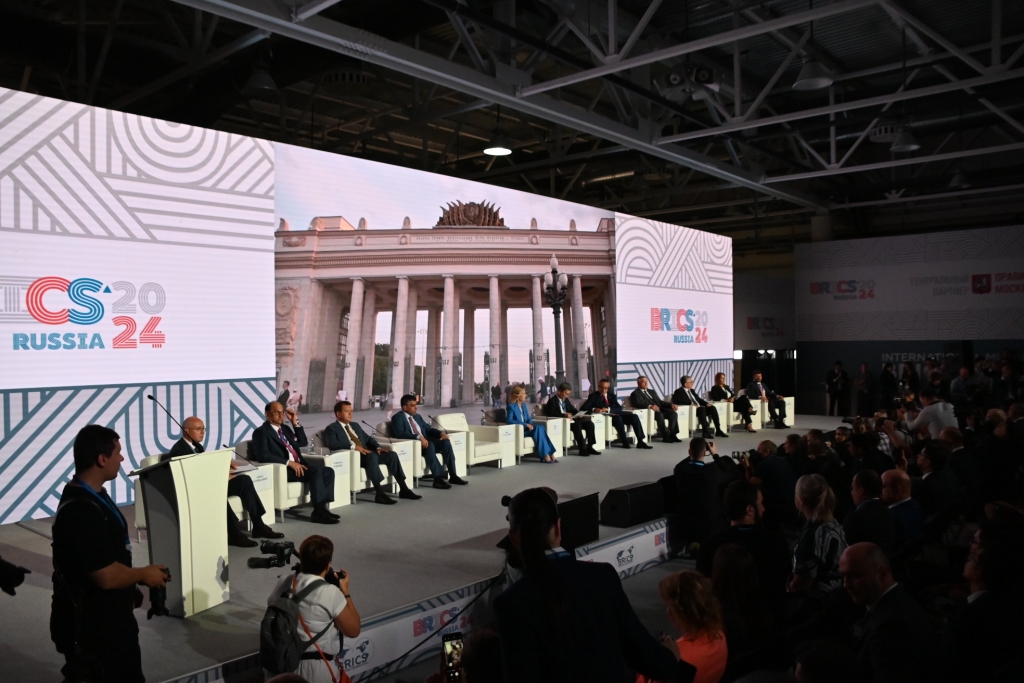
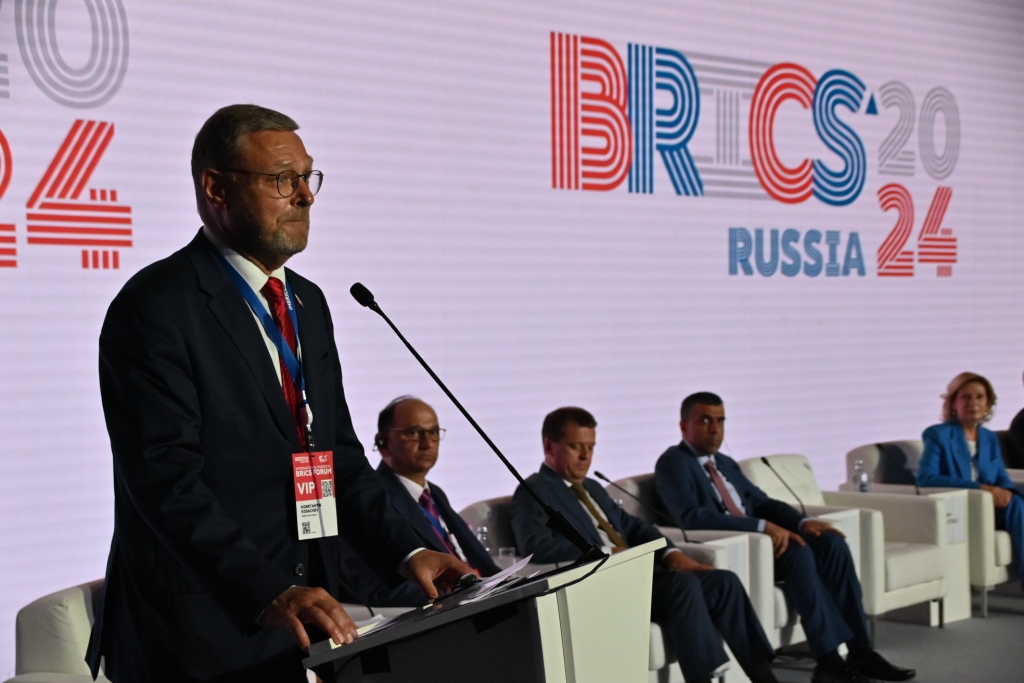
Sergei Lavrov, Minister of the Foreign Affairs of Russia, in his video address pointed out the importance of strengthening international cooperation at the municipal level, especially during the times of global challenges. Konstantin Kosachev, Deputy Chairman of the Federation Council, underlined that the BRICS is becoming a key element of global politics, causing discontent of a few Western countries.
The speakers at the plenary session were Mu Peng, Deputy Mayor of Beijing, Ekrem Imamoglu, Mayor of Istanbul, Tribhuvan Darbari, Chairman of the Indian Secretariat of the SCO Business Council, Bernardo Chim Rossi, Secretary for Environmental Affairs of the Government of the State of Rio de Janeiro and many others, including representatives of various regions of Russia. All of the speakers focused on the common subject: “key tasks and trends of development of megalopolises and their growing role”.
Strengthening Trade Diplomacy In BRICS Countries
The Forum featured a session themed “Role of chambers of commerce and industry of BRICS megacities in promoting economic and
entrepreneurial development”. The session was participated by representatives of almost all of the 10 BRICS member countries. Sergey Cheremin, Minister of the Government of Moscow, Head of the Department for External Economic and International Relations of Moscow (DEEIR) spoke at the session. He reported, that today Moscow is maintaining relationships with more than 150 countries and is actively implementing the practices of executing cooperation programs with major metropolitan cities, but with the capital cities of the BRICS countries being the top priority.
The Minister’s speech was vividly illustrated by the execution during the Forum of more than 300 agreements, aimed at development of municipal cooperation and expansion of economic ties with states in Africa, Asia, Middle East and Latin America. Among the most significant documents there was an agreement with Beijing on establishing joint digitalization and environmental protection projects.
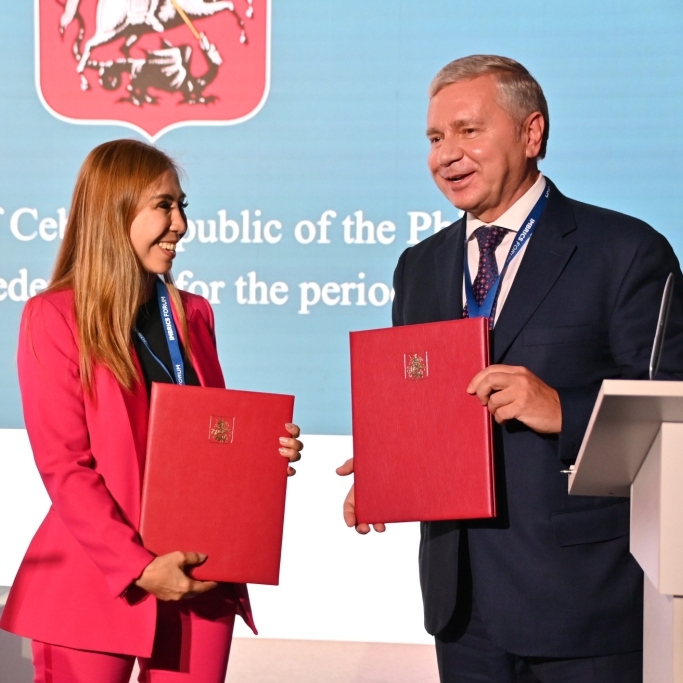
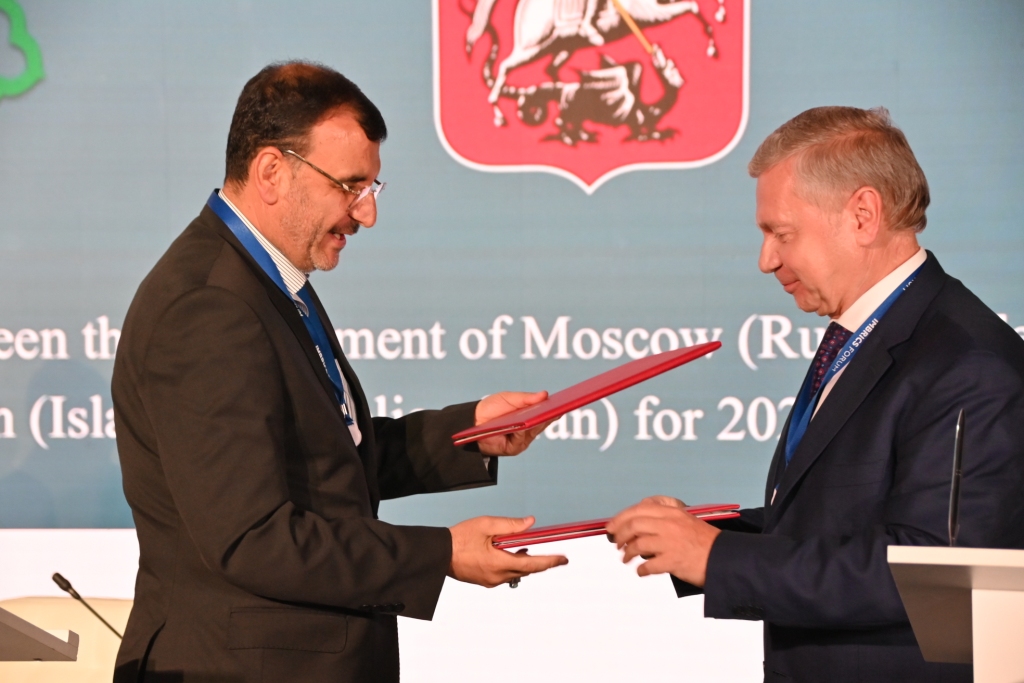
Moscow’s representatives also signed cooperation programs with their new partners, who had just recently joined the BRICS - the city administrations of Tehran and Sao Paolo, and also of Cebu, the second city in the Philippines by economic development level.
“Over the latest years Moscow has demonstrated major successes in developing foreign economic cooperation, - said Cheremin. – Just our cooperation with China last year, according to the customs department statistic, amounted to about $100 billion”. The Head of DEEIR also drew the attention of his colleagues to the growth of foreign trade turnover of Russia with India and other BRICS countries. Those numbers were achieved due to active support of businessmen by regional governments and municipalities, emphasized Cheremin.
It is no secret that the Government of Moscow over the latest years has been providing various preferences both for domestic and foreign business, and this is why, as the union partners correctly say, the Russian capital managed to maintain high economic development rates in most high-tech industries. Sergei Cheremin specifically emphasized this point in his speech.
“Just last year more than 900 small and medium businesses went on to become large companies, among other, due to our active joint efforts with the Moscow CCI to support their export potential growth, to provide opportunities for upgrading their property, plant and equipment and unprecedented preferences at our technopolises and industrial clusters, to ensure information and consulting support to Moscow businesses”, - pointed out the Minister.
The Moscow Chamber of Commerce and Industry regularly hosts meetings of the Business Council, where representatives of the DEEIR and other departments of the Moscow Government discuss the investment climate, new trends in Moscow’s legislation, which is most advanced from the viewpoint of comfort for running a business.
Sergei Cheremin reminded, that in 2022 UN-HABITAT recognized the capital city of Russia as the global leader in infrastructure development quality and quality of life.
“These achievements would have been impossible without Moscow’s broad international economic cooperation, this is why the Chamber of Commerce and Industry, the Moscow Export Center, our colleagues from the Department of Entrepreneurship and Innovative Development and other divisions of the Moscow Government do everything possible to increase the economic potential of Moscow’s enterprises”, - concluded the Head of DEEIR.
Vladimir Platonov, President of the Moscow Chamber of Commerce and Industry, in his turn noted that the goal of the IMF-2024 Forum is to create conditions for successful cooperation of the business community of the BRICS countries.
“The BRICS unites those countries that are willing to conduct their independent economic, international policy and are building a multipolar world”, - said Platonov.
The International Municipal Forum and the BRICS+ format are developing cooperation of megalopolises in various regions. “We have long-standing ties with many chambers of commerce and industry across the world. Nevertheless, our work at the BRICS forum is more transparent, open and interesting”, - as the Head of the MCCI supported Cheremin.
The key strong points of the Russian capital, highlighted by international experts, are development of the science and technology base, of the education system, labor market sustainability, digitalization and support of innovations”, said Platonov. He underlined that the chambers of commerce and industry of the partner countries would continue building mutually beneficial cooperation.
The session was also participated by Mohammed Alnuami, President of the Ras Al Khaimah Chamber of Commerce and Industry, UAE. In his opinion, the key objectives under the BRICS union are expansion of trade cooperation, improvement of business conditions and development of opportunities for international cooperation.
“The recent expansion of the BRICS is an excellent opportunity to give an extra impetus to our trade and business”, - pointed out Alnuami.
Mehdi Sadeghi, First Vice-President of the Tehran Chamber of Commerce, Industry, Mines and Agriculture, also spoke at the session. “The BRICS, - he said, - is a key union in the global economy, which will in the short term will become more important than the G7 or the European Union, in terms of the global GDP”.
The speaker noted that BRICS member states should improve international cooperation further. At the same time, Dr. Mehdi Sadeghi specifically focused on the major role of trade diplomacy. In his opinion, it is required to build relations between chambers of commerce and industry of different countries in order to make organization of business delegation activities easier.
Why Are Twin City Agreements Not Working?
The international session “Creation of innovative platforms for continuous dialogue between BRICS partner cities and regions” became one of the most significant events of the Forum. The session was co-organized by the DEEIR.
Sergei Cheremin, the session’s moderator, stated that currently there is ongoing search for new forms of cooperation, including interparliamentary cooperation, innovative platforms for sharing experience between megalopolises and municipalities are being developed. The capital of Russia continues to support active ties with all of its partners. This interaction used to be based on twin city agreements, but over the latest ten years there have been significant changes and “twin city” relations are no longer relevant.
“We have switched to executing three-year cooperation programs, addressing the most pressing issues of metropolitan cities – these are urban planning, infrastructure development, healthcare, education, tourism, digitalization. The transition to new cooperation forms has enabled us to achieve significant success in reviewing best international practices”, - said Sergei Cheremin. According to him, this has helped Moscow implement many significant projects, such as, for example, its intellectual traffic management system. The system was developed based on the experience of China, Singapore, Western European countries, Middle East.
As the DEEIR Head said, international exhibitions, conferences, participated by Moscow, have helped in studying cutting-edge international initiatives. And this also contributed to Moscow’s climbing to leading positions in international ratings in various areas.
“Now our most important partners, not only from the economic viewpoint, but in terms of cultural exchanges, humanitarian, inter-municipality relations, are Chinese regions and of course, the capital city of the PRC, Beijing, which has long-term friendly ties with Moscow”, - pointed out Sergei Cheremin.
The Minister also mentioned that Moscow’s representatives studied the extensive experience of Beijing in urban planning and transport systems, and also the practice of moving administrative offices to a new part of the city. This resulted in signing a new Program for cooperation of the two megalopolises for 2024-2026 this June, during the Days of Moscow in the capital city of the PRC.
Han Geng, Deputy Head of the Secretariat of the People's Government of Beijing, spoke at the session. He noted that the BRICS states have always protected the principles of multipolarity, actively participated in the global economic process and promoted development of global order in a more just and rational direction.
“In the spirit of openness and mutually beneficial cooperation of the BRICS countries, Beijing is actively expanding its cooperation and participating in various exchange programs with cities of the union”, - emphasized Han Geng. He invited all interested countries to cooperation and also to the use of the national comprehensive demonstration zone to improve openness and a pilot free trade zone in Beijing.
“We believe, that following the concept of cooperation with BRICS+, municipal interaction will be all means lead to a bright future for all participant countries”, - concluded Han Geng.
Diana Rodriguez, Director of International Relations of the Government of Caracas, relayed greetings from Venezuela’s President Nicholas Maduro, spoke about a transformation of municipal bodies activities in the capital city of Venezuela. According to her, the government has developed relevant initiatives for improvement of cooperation with the BRICS countries, learning their experience. This materialized in creating communes and other socially significant institutions, enabling ordinary citizens to take an active part in administration of cities and towns. A created model has become a showcase for the new system of administration for the city of Caracas and Venezuela as a whole.
“Recently another national people’s council has been held across the country and gave an opportunity to citizens to express their opinions, to make decisions on projects for road quality improvement, street lighting, municipal transport performance. The created system is designed to involve all layers of the population in managing their communities. And just recently the majority of Venezuelans have been denied their right to participate in local governance”, - said Diana Rodriguez.