

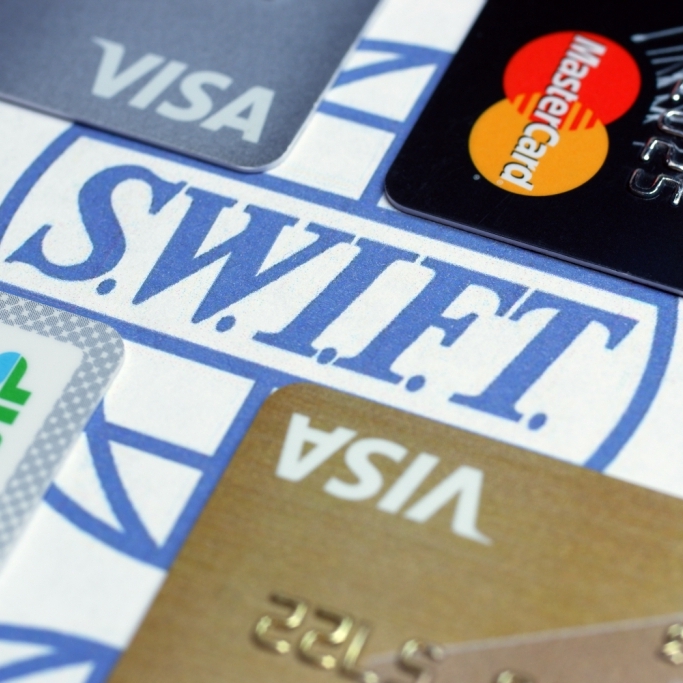
Americans Want To Trade With Russia, Bypassing SWIFT. Is This Possible?
Robert Agee specified, that AmCham is in a dialogue with the American government on issuing licenses to some banks, operating in Russia, to conduct operations in US dollars. “This is an opportunity we would need to consider, — said the AmCham head. — There are other ways and payment mechanisms apart from SWIFT, it’s not required to use this system only. So, I believe, now companies are very innovative in making cross-border payments. When the flow of finance through one channel gets shut down, it does not stop, it is redirected”.
Robert Agee, as experts point out, is indeed making active efforts to restore the bilateral ties between Russia and the USA. In June, for example, he participated in the Saint-Petersburg International Economic Forum (SPIEF), where he called to review the double taxation treaty between Russia and the USA. And this spring he eagerly gave interviews to Russian media. For instance, talking to the Expert magazine, Agee said that those American companies that are or were members of the AmCham, had lost around $100 billion after their exit from Russia. He added, that this number did not include all possible losses, “these mostly were forced discounts”.
Estimates by the Chamber could exclude the losses of those American companies that aren’t members of the AmCham. It is interesting that back in February Kirill Dmitriev, head of the Russian Direct Investment Fund (RDIF), said that the American business had lost over $300 billion at the backdrop of the exit from our country. Commenting on the statement, Agee noted that he was not aware of how did experts of the Fund calculate this number, but he assumed that if such effects as loss of market share and rising operational costs were included in these calculations, then it’s quite possible to get to $300 billion.
It is clear that this is a significant amount of capital for business, so it is no wonder that US businessmen want to come back to Russia. However, expert opinions differ on the possibility of launching trade between the two countries bypassing SWIFT and based on development of a bilateral similar system. So, according to Alexander Razuvayev, member of the Supervisory Board, Guild of Financial Analysts and Risk Managers, Russia is waiting for American investors in the bond and equity markets. This will enable raising capitalization of our stock market. It can be done without them, but with them it would be quicker and simpler. It would be much harder to get this done on our own. “But for all this to happen, the American sanctions on the Moscow Exchange have to lifted, — said the expert. — I believe this is a realistic scenario: it is quite likely this is what is going to happen”. And Russia does not need SWIFT — this is in principle a European story, Razuvayev emphasized.
To some degree, a step toward restoring the bilateral relations was made by the American government in early July. US President Donald Trump had lifted the sanctions from a number of Russian assets, according to the information, published on the website of the US Department of Treasury. Particularly, the “Russian Financial Alliance” bank, owned by Kirsan Ilyumzhinov, ex-president of the International Chess Federation (FIDE), was removed from the sanctions list. Moreover, sanctions were lifted from RFK-Bank, Tempbank and also the Iranian “Mir Business Bank”.
It was also reported that restrictions had been lifted from “Rosoboronexport”, “STG Logistic”, “Promsyrieimport” and “Global Group Concepts” organization. All of this was perceived as however small, but actual steps towards warmer relations between the two countries.
However, the joy was short-lived. And on July 14 during his meeting with Mark Rutte, NATO Secretary General, Trump announced of imposing “secondary duties of up to 100% on countries that buy Russian oil, if there is no progress in settling the Ukraine conflict over the next 50 days”.
White House Won’t Back Down
Unsurprisingly, other experts do not agree with Alexander Razuvayev. They point out, that no payment system would work without approval of the American government. Furthermore, even before the sanctions, the trade volumes between Russia and the USA had been very modest for such giant states. As noted by Natalia Milchakova, lead analyst of Freedom Finance Global, Russia already has its own SPFS system in place, which is an equivalent to SWIFT, there are similar systems available in China, India, Iran and a few other developing countries.
The USA also has its own payment system, not connected to SWIFT. An additional payment system for the RF and the US to conduct their mutual payments would not hurt the two countries, provided there is political will and desire of business in the two countries to resume cooperation. But this would take lifting sanctions first, at least those related to mutual foreign trade, including the embargo and the Russian oil “price ceiling”, and also resuming direct air transit between the two countries.
This would be an upside for Russia, because this system will enable setting up direct trade with the USA without unnecessary mediators from unfriendly countries, restoring normal business relations, making operations of the American business in our country simpler, and domestic companies resuming partner relations with the USA.
Downsides will mostly be related to the fact that the US and Russia historically have never been significant trading partners for each other: the previous mutual turnover has never been large. So creation of such a payment system would be more beneficial for the American business operating in Russia, rather than the domestic one.
Moreover, a new payment system in our country would be a competitor to the SPFS, so this leads to a quite logical question: wouldn’t it be more practical for the USA to lift the sanctions against the SPFS and make payments through this long-established and succesful system going forward?
A return of dollar trades at the Moscow Exchange seems to be unlikely, but it does not make a lot of sense, since the dollar is doing quite all right at the OTC market in Russia, the analyst pointed out.
Fear Of Disfavor
The main danger for business in setting up any “alternative to SWIFT” would be getting under restrictions of its own state. “For now there are no more or less specific plans for any possible alternatives to SWIFT — primarily because, regardless of any dependence on the type of such system, it would be in direct violation of the sanctions, leading to huge multi-billion fines and criminal prosecution”, — assumes Pavel Fedorov, founder of Fractio tokenization platform. Only complete cancellation of dollar circulation sanctions by the USA for all Russian financial institutions would be a reason to talk about complete restoration of dollar circulation at exchanges, the expert is sure.
Now there are alternative channels for international settlements already in use. “So, essentially, the head of the American Chamber of Commerce merely stated the facts, — says Anastasia Prikladova, Associate Professor of the Department of International Business at Plekhanov Russian University of Economics. — Maybe, he meant the use of the dollar in settlements, but this is a different issue. And speaking of a return of the dollar to the Moscow Exchange — this is a state prerogative, not a business one. And I do not see here any direct link to the condition of the trade relations between Russia and the USA. Payments can be settled through mediators, and then there could be conversion”. But speaking about a “SWIFT analog” between Russia and the USA, then development of one would only be feasible for quitting use of the dollar and probably, for a transition to digital currencies. Otherwise, companies would still face restrictions, warned Anastasia Prikladova.
In the opinion of Yulia Kuznetsova, President of the Association of Investment Advisors, this statement by the AmCham head is rather a political and economic signal, than a ready scenario. It means that under the sanctions pressure those American companies, interested in the Russian market, are looking for back channels. This does not signify a large-scale return of trade, but looks like a signal: “If there is a window, we are ready”.
Return Of Prodigal Greenback
A complete comeback of the dollar to the Moscow Exchange would be impossible with the sanctions against the National Clearing Center (NCC), which is still on the OFAC Sanctions List (a division of the US Treasury Department in charge of sanction regulations). Even if some companies manage to find some dollar payment arrangements, these will not be going through the exchange infrastructure of the RF. “If we speak of standalone mechanisms for going around the restrictions between the US and the RF, then these are already operational: through the Chinese CIPS (an analog to the Russian SPFS), Turkish or Emirates banks, and also through the SPFS system of the Bank of Russia. Speed is not the issue here, but legal and sanction risks are”, — Kuznetsova emphasized. So, launch of a comprehensive Russian-American “SWIFT analog” would require: a neutral site (most likely a country with a soft sanctions policy); a pool of banks, prepared to operate outside the mainline infrastructure; a political “permit” from the US Treasury Department, which is highly unlikely now.
If conditions are favorable and if there is a political window of opportunity, then a system of this kind could be launched in 6 to 18 months. But for now this is more of a theoretical scenarion. Similar timelines are mentioned by other analysts as well. “Unlike the mutual payment system of the RF and Turkey, which has been in development for many years, but no specific results have been reported yet, as we see it, if the sanctions are lifted, a Russian-American payment system could be up and running pretty quickly, possibly over a period from several months to a year, — says Natalia Milchakova. — Development of this system won’t require any major investments of millions of dollars, and it could pay back really fast with its message transfer fees”.
The conclusion is obvious: this is not about time or money costs of setup of a new international payment system. The situation is much more complex. According to expert Yulia Kuznetsova, the statement by the AmCham head is a trial balloon, a signal that there is business interest. But any real restoration of settlements and trade would require an eased sanctions regime and institutional guarantees for participants. This would be beneficial for Russia, but only under a sustainable and predictable configuration. For now this is a niche scenario for a few dozens of companies, as Kuznetsova summed up the abovementioned arguments. The contradictory policy of the White House is directly creating problems for interaction of its business with companies from the RF. Any moves forward in the area of bilateral relations would be impossible without Washington’s will.
Anna SOLNTSEVA
***
What is SWIFT system
Society for Worldwide Interbank Financial Telecommunications (SWIFT) is an international interbank payment system. Using this instrument, financial institutions can send orders to their foreign partners to transfer, convert currencies and also confirm trades and issue warranties for their customers. After the start of the SMO in February 2022 Russia was disconnected from SWIFT.
The American Chamber of Commerce in the RF
AmCham was established in 1994 as a non-profit organization for US businesses, operating in Russia. Its key objective is to facilitate the dialog between the American business and the Russian government. The headquarters of the Chamber are located in Moscow, there is an office in Saint-Petersburg. AmCham unites hundreds of companies from the USA, Europe and Russia. The Chamber is accredited with the Chamber of Commerce and Industry of the RF.