

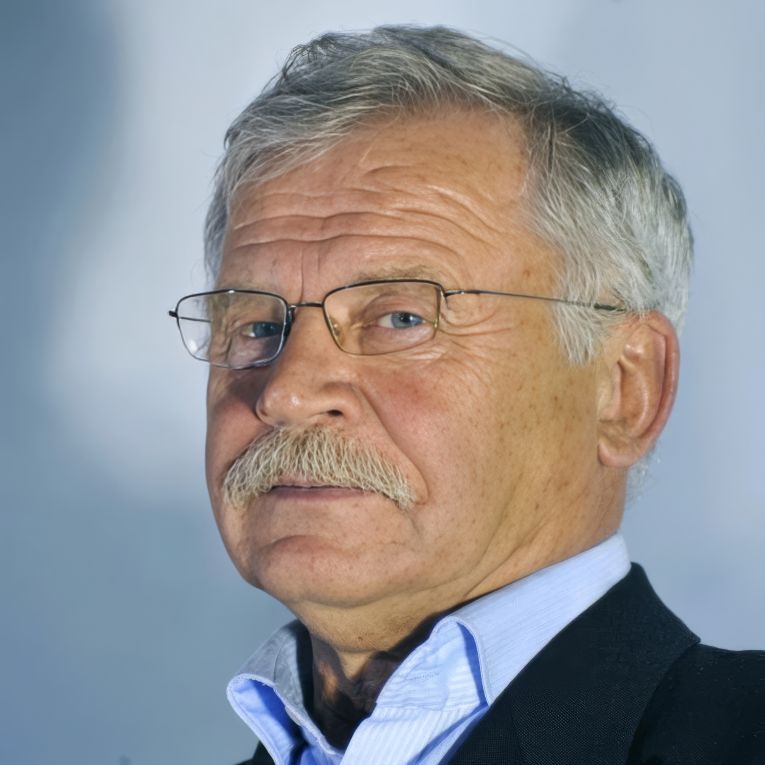
Sergei Nikonenko: “My whole life is connected with the Arbat and Yesenin”
- You have stated more than once that your entire life is tied to Moscow. Which of the capital's districts holds a special place in your heart?
- My homeland is Russia, Moscow, the Arbat. For 85 years now, I haven’t changed my registered address.
There were 25 tenants in my communal apartment on Sivtsev Vrazhek Lane. We all shared just one toilet and one bathroom. Our room was 13.9 square meters, and there were five of us: mom, dad, grandmother, my brother, and me. At various times, Nikolai Gubenko, Gennady Shpalikov, and the famous football player Eduard Streltsov lived in that little room.
Back then, Shukshin was a homeless VGIK graduate. He had defended his diploma but was denied a spot in the dormitory. He had nowhere to live and slept at the train station. One day I said, "Vasya, come over. I'll give you a cot." In the storeroom, he would spread a sheepskin coat over a chest, and when my parents went to the dacha—which my mother got through the electric lamp factory where she worked in the hot shop—he would sleep on the cot in the main room.
Once Nikita Mikhalkov asked me, "Hey buddy, can I crash at your place tonight?" He ended up staying for eight months—he and Nastya Vertinskaya were having some kind of falling out. The guy was simply born for communal apartment life; he bonded with the other tenants in no time. Rakhil Aronovna would fry fish for him, and Borya the barber would treat him to cabbage from the Dorogomilovsky market. Nikita was studying at the Shchukin School back then and rehearsing ‘12’ at my place.
Vladimir Kachan, Vadim Spiridonov, Kolya Eryomenko Jr., and Misha Zadornov all slept on my cot. Lyonya Filatov used to visit too. The cot vanished somewhere down the line. If everyone who slept on it had left an autograph, it would be absolutely priceless today!
- Do you, Sergey Petrovich, as a long-time Muscovite, like today's Moscow??
- It brings to mind the novel ‘The Year of Grace’ by the Russian writer Ivan Shmelev. In it, the main character exclaims, 'What a city Moscow has become!' He keeps making these exclamations throughout the book. And I agree with him. If Shmelev could see today's Moscow, which has become one of the most modern cities in the world, he would be struck dumb with amazement. Our city has absolutely everything for a prosperous and comfortable life—shops packed with food and clothes, restaurants, sports grounds, and beautifully landscaped parks. Granted, drivers—and I belong to that category myself—do grumble that the traffic jams downtown are infuriating! However, one cannot help but notice that Moscow Mayor Sergey Sobyanin is putting a lot of effort into solving this problem as well.
The Arbat area is particularly beautiful, clean, and easy to breathe in. The reconstruction of old mansions and former tenement houses is underway everywhere—they have been waiting for their renewal for over a hundred years. Yet, our famous building at 44/28 Sivtsev Vrazhek Lane seems to have been forgotten. No one here has heard anything about a major overhaul since 2023, and no construction workers or painters have been seen around.
The house at the intersection of Sivtsev Vrazhek and Denezhny Lanes was built in 1913 by the Russian architect Dmitry Chelishchev. The architect designed the five-story apartment building, where he settled with his family, in the Neoclassical style. Its facades are decorated with symmetrical bay windows with horizontal profiling, with the central one shaping the corner of the building.
Starting in 1913, Sergei Yesenin lived in this house, occupying a small room in communal apartment No. 14 with his first wife, Anna Izryadnova, and their son, Yuri. It also turned out that during the winter of 1938–1939, Sergei Alexandrovich’s mother, Tatyana Fyodorovna, was temporarily registered in the very same apartment.
Guided tours are frequently brought to our architecturally unique house, yet it remains in a state of disrepair.
I would like to take this opportunity to appeal to the Government of Moscow with a request to finally begin the long-planned reconstruction of this unique Moscow building in the Arbat district.
- You have been acting in films since 1960. Which role is the one that still hasn’t let you go?
- In 1971, I played Sergey Esenin in the movie ‘Sing Your Song, Poet...’ directed by Sergey Urusevsky and written by Gennady Shpalikov. I truly gave it my all and didn't cut any corners. I had to pour my entire self into the role, approaching the work of the great Russian poet with a sense of devotion and self-sacrifice. That’s what Sergey Gerasimov taught us at VGIK. His school of acting lives on in me to this day.
- So, you became genuinely obsessed with Esenin after ‘Sing Your Song, Poet...’?
- I actually discovered Esenin back in school, or rather, in the artistic speech studio at the Moscow City Pioneers Palace. Back then, though, I had no idea that he had actually lived in our building. We had an amazing teacher, Anna Gavrilovna Bovshik. She kept recommending Nekrasov, Tvardovsky, and Mayakovsky to me. As a result, I became deeply passionate about poetry. Then one day, my classmate and desk mate said, "Why are you so obsessed with Mayakovsky? Here’s a poet who’s just as good." And he handed me Esenin's poems. I read them and fell in love with everything he wrote forever. "How wonderful, smiling at a haystack, to chew on hay with the moon's snout." Such striking imagery!
At the time, Oleg Tabakov, Oleg Vidov, and Andrei Mironov auditioned for the lead role in the movie Sing Your Song, Poet... Shpalikov, who was a close friend of mine, brought me to Sergei Urusevsky and declared, "Here is your Yesenin!" They gave me a screen test. Mikhail Ilyich Romm was the artistic director of the film unit back then. When he saw my screen test, he exclaimed, "I saw Yesenin alive. He looked exactly like Nikonenko!" So, I was cast as Yesenin because of the resemblance.
This picture was practically buried through the efforts of Yermash, the then-chairman of Goskino; they only released 16 prints for the entire USSR. And for Gena Shpalikov, this film became his last work in cinema: shortly after, he committed suicide…
- When did you finally decide to organize the Yesenin Museum on Arbat?
- The filming of the movie about Yesenin wrapped up in 1970. Twenty years later, I was re-reading the memoirs of the poet's first wife, Anna Izryadnova, who, as I mentioned before, lived in Sivtsev Vrazhek at the beginning of the last century. I went to the DEZ (district maintenance office) and asked if the old house registers were still there. They led me into a basement and opened a door covered in sheet iron. Behind it were dirty floors, cobwebs on the ceiling, and shelves lined with folders. I took a rag and a bucket of water and cleaned the place up. Then I made myself comfortable and started going through the house registers dating back to the first half of the last century.
It turned out that in Sivtsev Vrazhek, in building 44/28—where I was born and still live today—in communal apartment No. 14, Yesenin's common-law wife, Anna Izryadnova, had indeed lived since 1921.
According to archival records, in the spring of 1913, 17-year-old Sergei Esenin was hired as an assistant proofreader at Sytin's printing house on Arbat. There, he met proofreader Anna Izryadnova. They began dating, and in December 1914, Anna gave birth to Esenin's son, Yuri.
Family bliss, however, did not last long. Esenin left for Petrograd to find work. He would return to Moscow and stay at his wife's home, sometimes for long periods. Her small room was cozy, and Esenin was always welcome there. Sergei Aleksandrovich used it to hide from annoying admirers and drinking buddies. It was his sanctuary, an address he shared with no one.
In the 1990s, apartment No. 14, located on the ground floor, was occupied by no one but the homeless. By that time, its last owner had passed away, and the apartment had turned into a flophouse. Squatters smashed the windows and tore out the radiators—likely selling them for scrap. They even lit bonfires inside. I honestly don't know how the house didn't burn down, considering it has wooden floors. That was when it hit me: I had to establish a Esenin memorial corner here.
In 1994, my very first step was to convert the premises from residential to non-residential status. Then began my long odyssey of dealing with bureaucrats and gathering documents to establish the museum. This went on for a year and a half. As a result, we opened the very first Esenin Cultural Center in Moscow.
We don't just collect rare items related to Esenin; we preserve historical Moscow. In this neighborhood, adjacent to building 44/28 on Sivtsev Vrazhek, lived Pavel Florensky, Valery Bryusov, and Maximilian Voloshin. Leo Tolstoy used to come here to visit the philosopher Solovyov. This part of the Arbat district was frequented by Pushkin, Andrey Bely, the poet Alexander Tikhomirov, and Dmitry Ushakov, the author of the orthographic dictionary. It is simply a Russian Parnassus! If the French had a courtyard like this, visited by the likes of Béranger, Stendhal, Molière, and Baudelaire, they would be immensely proud of it.
- I’m sure your museum has a guest book where visitors leave their reviews and suggestions.
- We do indeed have such a book, and it's filled with comments from all kinds of people. Mostly, they express gratitude for keeping the memory of the great poet alive. Let me tell you about one of our famous guests. Back in 2005, the museum was visited by none other than Seryozha Bezrukov, who was starring in the TV series Esenin at the time. He knew that among the museum’s rarities, there was a glass that Esenin himself had held many times.
"Petrovich," the actor asked, "let me have a drink from this glass!" He poured himself some vodka, downed it, and went off to play Esenin.
- Do you have your own version of how Sergey Yesenin died?
- The official version of Sergei Yesenin's death is suicide. The poet passed away on December 28, 1925, in the Leningrad hotel "Angleterre." I have examined many documents and believe that he was murdered, this is supported by various pieces of circumstantial evidence. For instance, the autopsy report mentions "minor injuries" on Yesenin's body. It is also noted historically that his final poem, "Goodbye, my friend, goodbye," was written in his own blood due to a lack of ink. This raises questions regarding the nature of the deeper wounds found on Yesenin's arms and whether they could indicate the presence of an assailant. As always, there remain more questions than answers.
- Sergey Petrovich, how many movie roles have you played in total? How many films have you directed?
- Recently, some friends of mine calculated that over my entire cinematic career, I have directed 17 films and played 234 roles.
- Could you tell us about filming your first feature movie, "Birds Over the City" (1973)?
- It was a successful debut. The movie was broadcast across all TV channels for about 20 years. At the Gorky Film Studio, there was an unwritten rule: a novice director was assigned the best cinematographer and the best production designer. On top of that, for the leading role, I personally chose a powerhouse actor—Mikhail Andreevich Gluzsky. He was incredibly meticulous and picked at everything he didn't like. Practically every day, I had to pass Gluzsky's exam in directing.
The cinematographer, Vyacheslav Shumsky, was a top-tier professional and a wonderful person. He shot all of Stanislav Rostotsky's movies. Shumsky would ask very politely and softly: "Should we shoot this with a tracking shot, a pan, or maybe keep it static?"
Or the production designer, Dulenkov, who had previously worked with Gerasimov on "And Quiet Flows the Don." You can imagine what powerful creative giants they were! They were constantly asking me questions, and I had to have the answers.
- You once mentioned that your role in Sergei Gerasimov's film “The Journalist” (1967) became one of the most significant in your career. Why?
- We shot this movie in the Chelyabinsk region, in the city of Miass. Working on the role of Alexander Reutov, the editor of “The Gornouralsky Rabochy” newspaper, taught me how to improvise—a skill that not every actor fully commands. Sergey Gerasimov, like a true teacher, brought his pedagogical skills right onto the set. He was incredibly patient, waiting take after take for the right scene to come alive.
One day Gerasimov said, “Guys, I can hear how wonderfully you talk. You conscientiously memorize your lines and diligently rehearse. But try translating that into everyday speech; try to improvise on the given topic”'.
Usually, Gerasimov would only shoot one or two takes because we were well-prepared and rehearsed a lot. But when we started improvising on the master’s advice, he said, 'Oh, that's interesting! Let's try something else, shall we?' And so we did three takes, five, seven... He loved everything. Eventually, he said, 'Well, I think that's enough. You’re starting to repeat yourselves now.' For us, his students, it was a remarkable school of acting".
- Who did you study with at the acting department?
- It was a legendary class — Nikolai Gubenko, Evgeny Zharikov, Valera Malyshev, Zhanna Bolotova, Zhanna Prokhorenko, Galina Polskikh, Larisa Luzhina, Lidiya Fedoseeva-Shukshina.
- You starred in the family melodrama “Love as Love” (2006). That’s 320 episodes! It must have been a massive and grueling job?
- I look back on that TV series with pleasure. The thing is, I made a ton of money back then and used it to build a house in Peredelkino.
- What stood out to you most about the TV series “Kamenskaya”, where you played Police Colonel Gordeev, nicknamed Kolobok?
- Haven't you noticed? In over 80 episodes, Kolobok never once used a weapon!
The first season of this detective series was directed by the wonderful Yuri Moroz. There's a good reason why his episodes of “Kamenskaya” are constantly rerun on all TV channels.
On July 14, 2025, Director Moroz passed away….
- If you had the chance to see Vasily Makarovich Shukshin just one more time, what would you talk about?
- About life…
- What do you dream of, Sergey Petrovich?
- I pray to the Lord for our swift Victory and for peaceful life on Earth.
*Photo from Sergei Nikonenko’s private archive